A creator posts about an AI assistant she uses and finds the response has changed. Nothing dramatic. No campaign, no pile-on, no apology demanded. Just a measurable cooling: fewer replies, quieter comments, a brand conversation that goes unanswered. She calls it being micro-cancelled, and says that using AI has become a social taboo.
The instinct is to file this under backlash, and there is certainly a backlash to file it under. American adults who think AI does more harm than good rose from 31 per cent last year to 39 this year. The share who say they feel excited about it has fallen from 50 per cent to 19 in two years. Among artists the rejection is close to total, with surveys finding 85 per cent abstaining from these tools entirely and 88 per cent refusing to use them to generate images.
But backlash is the wrong frame, because it implies a public that has considered the technology and rejected it. What the evidence actually describes is stranger. Almost everybody is using the thing. Almost nobody can afford to say so.
The penalty is real, and it has been measured
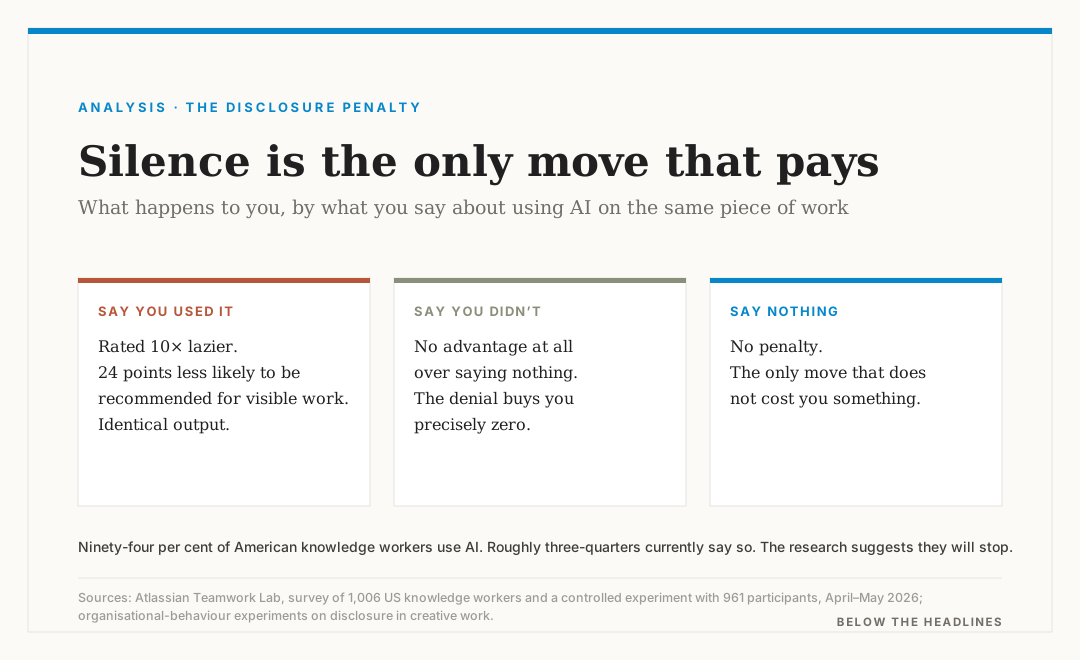
In April and May, Atlassian’s Teamwork Lab ran a double-blind survey of 1,006 American knowledge workers alongside a controlled experiment with 961 participants. The survey found that 94 per cent of them use AI at work. Roughly three-quarters currently admit it.
The experiment is the part that matters. Participants assessed identical work, varying only in whether the worker had disclosed using AI to produce it. Those who disclosed were rated ten times lazier. They were 24 percentage points less likely to be recommended for high-visibility projects. The output was the same. Only the sentence about how it was made had changed.
Separate experiments by organisational-behaviour researchers found the same effect in creative work and added two details that make it worse. In one, participants judged a piece of music attributed either to the Academy Award-winning composer Hans Zimmer or to a first-year music student, with or without a note that it involved collaboration with AI. The reputational damage landed on both. An established reputation did not insure against it.
In the second, researchers tested four positions: admitting AI use for creative work, admitting it only for admin, explicitly stating you avoid AI, or saying nothing. Declaring that you had not used AI produced no advantage whatsoever over silence. The denial bought precisely nothing.
Put those findings side by side and the strategic picture is unusually clean.
Which is why the taboo will keep growing while the behaviour does too
Admitting is punished. Denying is worthless. Silence costs nothing. There is no game here: silence wins, for everyone, every time.
And silence compounds. Each person who quietly uses the tool and says nothing makes the visible consensus look a little more hostile than the private one really is, which raises the cost of speaking for the next person, who then also says nothing. The norm is not sustained by the people who hold it. It is sustained by the far larger number who do not hold it and cannot afford to say so.
Economists have a name for this. Preference falsification is what happens when the private distribution of opinion and the public distribution come apart, and it produces two reliable effects. The public norm looks far more settled than it is. And when it moves, it moves suddenly, because everyone discovers at once that they were never the only one.
Everybody assumes everybody else is doing it
Both figures cannot be true. Researchers reading the gap concluded that people systematically under-report their own use.
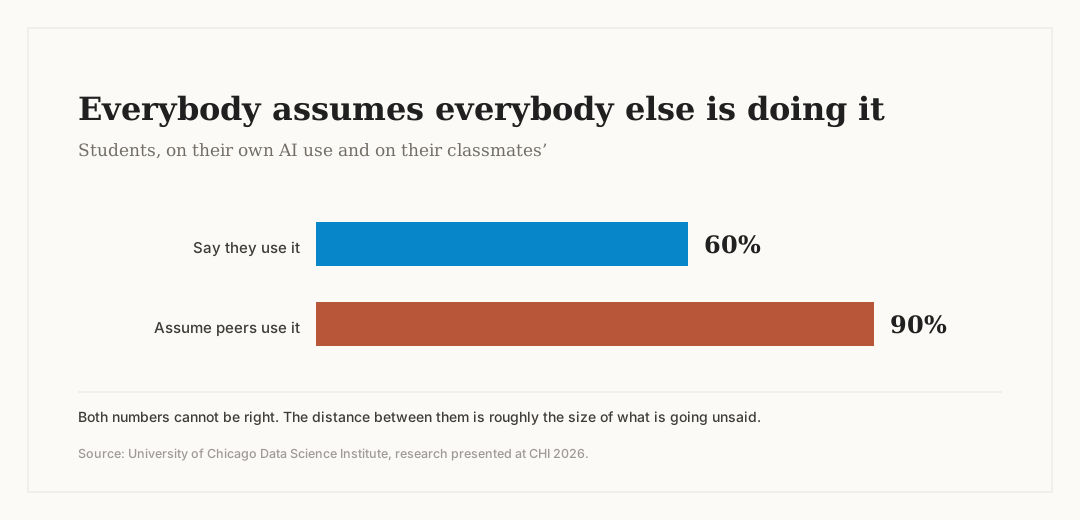
The clearest illustration comes from a study of students, who reported using these tools at a rate of roughly 60 per cent while estimating that around 90 per cent of their classmates did. Both numbers cannot be right. The researchers concluded that people were under-reporting themselves, which is the signature of a social-desirability effect rather than a considered position.
So who is actually enforcing it
This is the part worth being careful about, because the temptation is to describe a mob and there does not appear to be one.
The creator in this story was not subjected to a campaign. She experienced a diffuse withdrawal: slightly less engagement, slightly more hesitation, a sponsor who went quiet. Nobody organised it and no one person is responsible for it. It is the aggregate of several thousand individually reasonable decisions not to be seen endorsing something contentious.
That is precisely what makes it hard to argue with. There is no position to rebut, no argument to answer, no accuser to face. There is only a cost that arrives without a sender, and the rational response to a cost like that is not to change your behaviour but to stop mentioning it.
What the silence actually costs
It would be easy to treat all of this as an etiquette problem. It is not.
When AI use goes underground, an organisation loses the ability to see it. It cannot learn from the people using these tools well, cannot spread what works, and cannot catch what is going wrong, because the entire practice has moved somewhere it cannot be observed. The same applies to a profession, or a classroom, or a creative field. A norm that punishes disclosure does not reduce use. It reduces knowledge about use, which is a different thing and a worse one.
It also transfers the advantage to whoever is least troubled by the norm. If admitting to using a tool is costly and using it is not, the people who benefit most are those with the least reputational exposure and the fewest scruples about disclosure. The taboo does not slow adoption. It selects for people who do not mind lying about it.
The one variable that changes the outcome
There is a finding in the Atlassian work that gets much less attention than the ten-times-lazier number, and it is the most useful thing in the entire literature.
In organisations that actively celebrate AI use, the laziness penalty nearly disappears.
Which means this is not a fact about the technology. It is a fact about local norms, and local norms are contingent, contested and reversible. The same disclosure that costs a person 24 points of professional standing in one workplace costs nothing in the workplace next door. The taboo is real in its effects and arbitrary in its content, and it is being enforced overwhelmingly by people who are themselves using the thing.
None of which settles whether the criticism is correct. There are serious arguments about labour, consent, training data and the flooding of creative markets, and they deserve to be argued on their merits by people willing to put their names to them. What the evidence does settle is that we are not currently having that argument. We are having a much smaller one, in which almost everybody agrees in private and performs disagreement in public, and the only real penalty falls on whoever speaks first.
That arrangement is stable right up until it is not.
This is the layer below the headline.
Sources
Every figure in this piece traces back to a published document or report. Follow them.
- New research shows honesty about AI use at work is backfiringAtlassian Teamwork Lab
- Artists and writers are often hesitant to disclose they’ve collaborated with AI, and those fears may be justifiedThe Conversation
- Are students hiding their AI use? The social stigma behind AI use in the classroomUniversity of Chicago Data Science Institute
- The AI-inflected crisis artists are facing, in four chartsBlood in the Machine
- The more people learn about AI, the more they want it out of their livesFuturism, on Bentley University and Gallup polling
- Why hide AI use? Psychological configurations and evidence from marketing workBehavioral Sciences