Natron Energy’s board met on 27 August last year and concluded that the money had run out. The company had spent 13 years and $363 million building sodium-ion batteries in America. Its plant in Holland, Michigan had been open barely 12 months. A $1.4 billion factory in North Carolina had been announced. Within a week the staff were gone and the assets were with a liquidator running a private sale, which is the quiet version of failure.
The batteries worked. What failed was an assumption about somebody else’s product.
Sodium-ion exists because it avoids lithium, and therefore avoids lithium’s price. Lithium carbonate then fell from around $70,000 a tonne in 2022 to roughly $8,100 by the middle of 2025, and the cheap alternative stopped being cheaper than the thing it was an alternative to. Two months before Natron gave up, CATL had put the same chemistry into mass production in China and sold it on entirely different grounds.
This is the part that rarely survives into coverage of battery research. A technology marketed as the affordable option is not really competing on its own merits. It is a position on the price of the incumbent. It is a business while the incumbent is expensive and a science project while the incumbent is cheap, and the quality of its engineering has strikingly little to do with which of those it is in any given quarter.
Hold that up against the sodium-ion announcement that circulated this summer, and almost everything interesting about it sits outside the press release.
The result that got the coverage
A team at the University of Surrey worked on sodium vanadate hydrate. Standard practice is to bake water out of such cathode materials, on the assumption that moisture degrades them. Daniel Commandeur and colleagues left it in. The structurally bound water nearly doubled the charge the material could hold compared with typical sodium-ion cathodes, putting it among the stronger results reported for this battery type. The paper appeared in the Journal of Materials Chemistry A, and it is explicit that the work is early and needs a great deal more testing.
The coverage kept that first clause and dropped the rest. Here is the rest, assembled from the same paper, from the companies manufacturing these cells, and from the research literature the announcement did not mention.
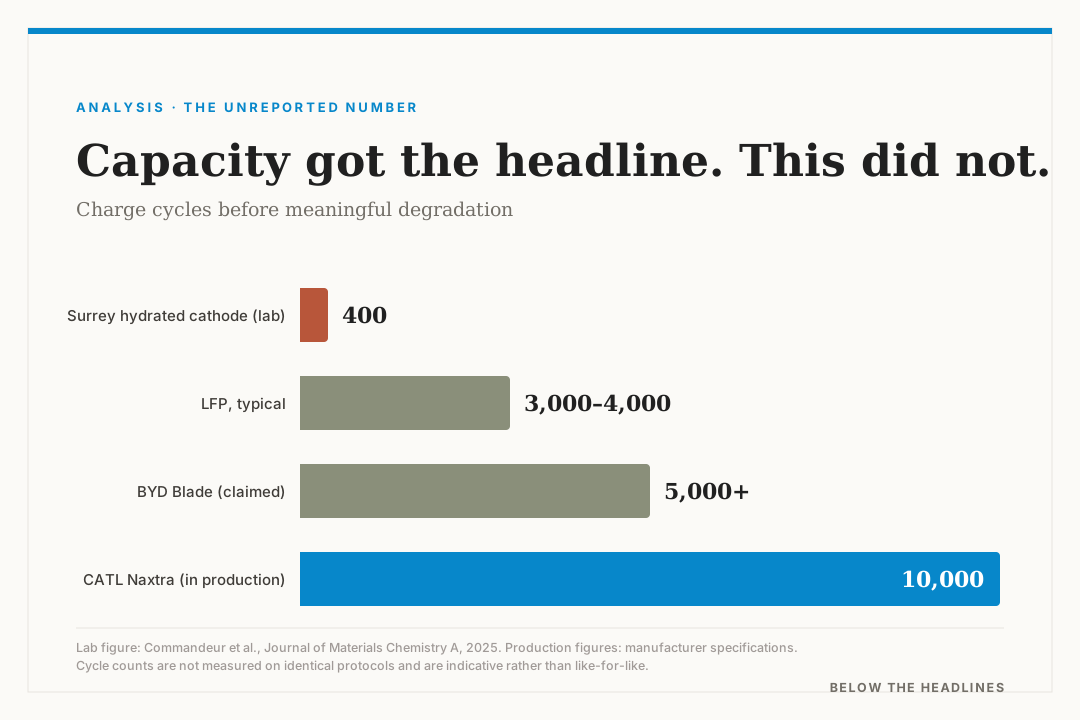
The material held up for more than 400 charge cycles.
Grid storage, the application sodium-ion is most often proposed for, is charged and discharged roughly once a day. At that rate, 400 cycles is about 13 months. Typical lithium iron phosphate cells manage 3,000 to 4,000. BYD claims more than 5,000 for its Blade cell. CATL’s Naxtra sodium-ion cell is rated at 10,000.
That is an entirely normal figure for a materials paper at this stage, and nobody in the laboratory is pretending otherwise. It is not a normal figure for a battery. It is also worth saying that these numbers are not measured on a common protocol, and the manufacturer figures are specifications rather than independent test results. The order of magnitude is the point, not the decimal places.
The assumption it was said to challenge
The announcement frames the finding as overturning a conventional belief that moisture damages battery materials. That framing does not survive 10 minutes in a database.
Structural and interlayer water in hydrated vanadium oxides has been an active research subject for years, largely in aqueous zinc-ion batteries, where the water molecules are understood to act as “pillars” holding the layered structure open, stabilising it through cycling and improving ion transport. There is published work on comparing layered hydrated vanadium oxide against its dehydrated counterpart, on pillaring with potassium and aluminium ions, on organic molecules doing the same job, and specifically on stabilising hydrated vanadium oxide by pre-intercalating sodium ions in place of some of that water.
This does not diminish the Surrey result. Most of that literature sits in zinc-ion chemistry, and carrying the mechanism into a sodium-ion cathode with this performance may well be new. But the orthodoxy being challenged had already been under sustained attack from a substantial field, and a reader told that researchers had defied conventional wisdom has been given a story about lone insight rather than about cumulative work.
The dual-function idea is fourteen years old
The most interesting line in the announcement is near the bottom. The material worked in saltwater, and while storing charge it pulled sodium and chloride out of the water: electrochemical desalination as a by-product.
That idea has a name and a date. Researchers at Stanford and Ruhr-Universität Bochum published “A Desalination Battery” in Nano Letters in 2012, using a sodium manganese oxide electrode paired with silver-silver chloride, reporting 0.29 watt-hours per litre to remove a quarter of the salt. Electrochemical desalination has been a recognised field ever since, with its own review literature and a substantial body of work on Prussian blue analogues doing the same job.
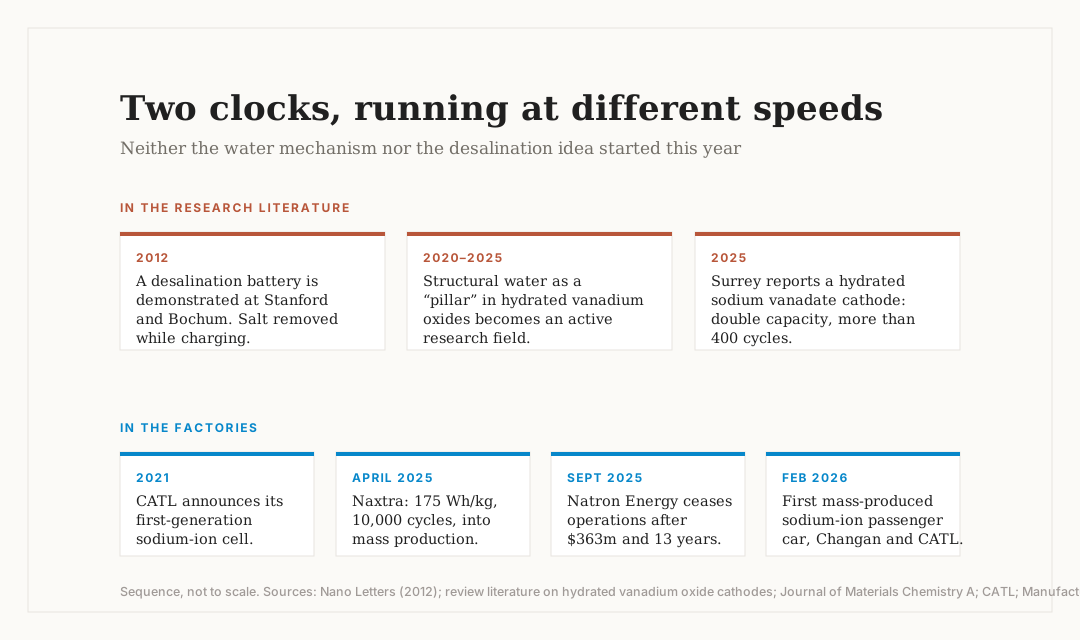
Two clocks, running at different speeds
The mechanism and the application both have a lineage. So does the commercial technology they would have to beat.
What the factories did meanwhile
On 21 April 2025, CATL announced Naxtra and described it as the world's first mass-produced sodium-ion battery. The specification is worth reading rather than summarising: 175 watt-hours per kilogram, which the company positions as comparable to LFP; over 10,000 cycles; an operating range from −40°C to 70°C, holding 90 per cent of usable power at −40°C even at 10 per cent state of charge. A heavy-truck start-stop variant is rated for over eight years of service.
By February 2026 the first mass-produced sodium-ion passenger car, developed by Changan with CATL, had been unveiled. The International Energy Agency's assessment is that momentum is real while challenges remain, which is roughly where the evidence sits.
Note what CATL leads with in its own material. Not price. The pitch is reducing dependence on lithium resources and moving away from single-resource dependence. The largest battery manufacturer in the world is selling sodium-ion as a supply-security product, and that is the tell for everything below.
Cheap only while lithium is expensive
Natron used Prussian blue analogues, not vanadium, and was chasing fast-cycling applications such as data centres. The layoffs ran to 95 people, and the company chose an assignment for the benefit of creditors over Chapter 11, which liquidates quietly and without much court scrutiny. None of that was a verdict on the chemistry. It was a verdict on the premise.
The arithmetic is stark. Lithium carbonate’s fall from roughly $70,000 a tonne in 2022 to about $8,100 by June 2025 is a decline approaching 90 per cent, and it had recovered into the mid-$20,000s by early 2026. Meanwhile cell manufacturing overcapacity drove LFP pack prices to record lows.
Sodium-ion cells now sit at roughly $50 to $56 per kilowatt-hour against $52 to $55 for LFP. That is parity, and the forecasts showing sodium-ion undercutting LFP next year are assuming lithium behaves, which is the assumption that has been wrong in both directions for four years.
Natron is not the only casualty. Kingshine cancelled a proposed six-gigawatt-hour facility in Jiangxi in early 2024, and Veken Tech postponed a two-gigawatt-hour project by a year. Sodium-ion is commercialising and contracting at the same time, in different places, which is what a technology looks like when its economics are set somewhere other than in its own factories.
The abundance argument has a vanadium problem
If cost is not reliably the argument, supply security is, which is exactly where CATL is pointing. Sodium-ion avoids lithium, cobalt and nickel. That is a serious claim in a decade organised around critical minerals.
Which is where the Surrey material becomes awkward in a way none of the coverage mentioned. It is a vanadium compound.
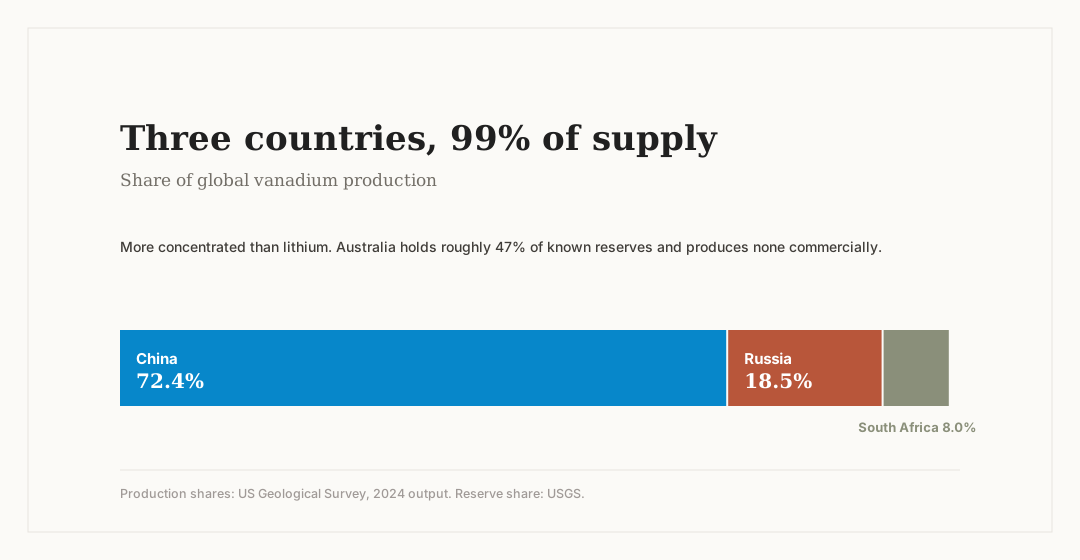
China produced roughly 72 per cent of the world’s vanadium in 2024. Russia supplied about 18.5 per cent and South Africa around 8. Three countries account for close to 99 per cent of supply, a tighter concentration than lithium has ever had. Australia holds something like 47 per cent of known reserves and produces none of it commercially, which is precisely the reserves-are-not-supply confusion that produced a decade of confident and wrong predictions about rare earths.
Three countries, 99% of supply
An escape from critical-mineral dependence that would run through a more concentrated mineral than the one being escaped.
Vanadium is not a fringe choice in this field. Vanadium phosphate is a recognised sodium-ion cathode family and Tiamat in France has built on it. But commercial momentum runs the other way: the layered oxides CATL and its competitors are scaling use nickel, iron, manganese and copper, and one of the fastest-moving polyanionic candidates, a mixed iron phosphate known as NFPP, is being pursued specifically because it is vanadium-free. Flow batteries are competing for the same vanadium supply.
The industry is engineering away from vanadium while a widely shared story about escaping critical minerals was, in this instance, running on one.
What the water-and-salt idea would actually need
Return to the desalination, because it is still the part with the most upside, and it deserves a fair hearing rather than an excited one.
Removing salt electrochemically is not obviously cheaper than the incumbent. Seawater reverse osmosis runs at roughly 3.6 kilowatt-hours per cubic metre. On brackish water one study puts reverse osmosis at 0.09 kilowatt-hours per cubic metre against 0.85 for capacitive deionisation, more than eight times the energy, although pilot work on membrane variants has reported the ordering reversed against low-pressure reverse osmosis. The 2012 figure of 0.29 watt-hours per litre sounds excellent until you notice it removed a quarter of the salt, which is not drinking water.
The interest was never that this beats reverse osmosis on energy. It is that one device might do two jobs. Grid storage and water treatment are both capital-heavy, both constrained by land and permitting rather than demand, and increasingly needed in the same places: the Gulf, southern Spain, western India, inland Australia, the American southwest. A system that stores afternoon solar and leaves fresh water behind is two business cases sharing one set of civil works, which is a different conversation with a planning committee.
And that is where the whole thing closes back on itself. A dual-function device is only worth anything if it survives. Electrodes cycled in brine face fouling and degradation that clean electrolyte does not impose, so the operating environment that makes the idea attractive is also the one most likely to shorten its life. The most consequential possibility in the paper depends entirely on the number the coverage left out.
Why capacity is the figure that travels
There is a reason this happens to nearly every battery story, and it is not laziness.
Capacity is a single number. It goes up. “Nearly double” requires no explanation and survives translation into a headline. Cycle life requires knowing the duty cycle, the depth of discharge, the temperature and somebody’s definition of end-of-life. Calendar ageing requires waiting years to measure. Levelised cost over a lifetime requires all of them at once, plus assumptions about electricity prices. Supply concentration requires knowing which element you are looking at and where it comes from.
So the public conversation about energy storage runs almost entirely in the one variable that matters least to whether a battery ever gets manufactured. The consequence is a decade of breakthroughs that never arrive, alongside a genuine industrial achievement, sodium-ion reaching LFP energy density with a 10,000-cycle rating in mass production and going into a production car, that drew less attention than a laboratory cathode.
It also creates a quiet incentive problem. Press offices are rewarded for the legible number, and the legible number is the one least likely to be the constraint.
What would actually be news
A materials paper reporting 3,000 cycles at an unremarkable capacity would matter far more than one reporting double capacity at 400, and would receive a fraction of the attention.
The specific things worth watching from this work are narrow and unglamorous. Whether the hydrated structure holds its water through extended cycling, since that is the entire mechanism. Whether cycle life in brine can be brought near cycle life in clean electrolyte, because the desalination idea lives or dies there. Whether the capacity advantage survives being scaled from a laboratory coin cell to a commercially relevant electrode thickness, which is where a large share of promising cathode results quietly stop.
And in the wider market, whether anyone outside China can build a sodium-ion business that does not depend on lithium staying expensive. Natron could not. General Motors is now backing sodium-ion for American grid storage through Peak Energy, and MIT Technology Review named the chemistry one of its breakthrough technologies for 2026, so the attempt continues. It will be decided by cycle counts and supply contracts rather than by capacity figures.
None of that will make a headline. All of it will decide whether any of this leaves the building.
This is the layer below the headline.
Sources
Every figure in this piece traces back to a published document or report. Follow them.
- Water trapped in battery material nearly doubles storage capacityScienceDaily, on University of Surrey research
- Nanostructured sodium vanadate hydrate as a cathode material (DOI 10.1039/d5ta05128b)Journal of Materials Chemistry A
- A Desalination Battery (Nano Letters, 2012)Pasta, Wessells, Cui et al.
- Stability and kinetics enhancement of hydrated vanadium oxide via sodium-ion pre-intercalationMaterials Today Energy
- Naxtra battery and dual-power architecture, 21 April 2025CATL
- Sodium-ion battery maker Natron Energy shuts down, halts $1.4B factory plansManufacturing Dive
- Sodium-ion battery momentum grows, but challenges remainInternational Energy Agency
- Lithium market 2025 year-end reviewNasdaq
- Cell design and chemistry of commercial sodium-ion battery cellsJournal of Power Sources
- Top vanadium-producing countriesInvesting News Network, on USGS data
- Comparison of energy consumption in desalination by capacitive deionization and reverse osmosisDesalination
- GM backs sodium-ion batteries for U.S. grid storageIEEE Spectrum