Michael Burry has spent 10 months telling anyone who will listen that the artificial intelligence build-out is an accounting story before it is a technology story. The headlines have compressed that into something simpler: the man who shorted the housing market thinks AI is a bubble. Compression is what headlines do. What it has buried here is the more useful fact, which is that Burry has made two separate arguments, on two different timescales, and they are not holding up equally well.
The first is about depreciation schedules. The second is about how the whole build-out is financed. Only one of them is currently being contradicted by observable prices, and it is not the one most readers would guess.
A short timeline, because the order matters
Burry told his investors he was closing Scion Asset Management in a letter dated 27 October 2025. The reason he gave was not a market call but a mismatch: “My estimation of value in securities is not now, and has not been for some time, in sync with the markets.” The firm’s registration as an investment adviser was terminated on 10 November. Days before that, Scion’s final quarterly disclosure had shown bearish positions against Nvidia and Palantir: puts on a million Nvidia shares, carrying a notional value of about $186.6 million, and roughly $9.2 million spent on Palantir options struck at $50 and running into early 2027.
Then he did the thing nobody expected from a manager who had spent two decades refusing to explain himself. He started a newsletter.
Cassandra Unchained launched in November 2025 at $39 a month, with a $400 founding tier. By mid-2026 it carried around 300,000 subscribers across 212 countries and sat second on Substack’s finance leaderboard. Substack’s figure mixes free and paying readers, and Burry has never broken out the split. The distance between those two numbers is the distance between a widely read blog and a business earning more than Scion did in its final years.
The claim that made the headline
The depreciation argument is the one that travelled, partly because its logic fits in a paragraph. A company that buys equipment spreads the cost across the years it expects to use it. Stretch that period and this year’s expense falls, so this year’s profit rises, while nothing real has changed. Burry’s position is that the hyperscalers have been stretching.
Understating depreciation by extending useful life of assets artificially boosts earnings — one of the more common frauds of the modern era.
He attached a number to it: roughly $176 billion of depreciation expense deferred across the industry between 2026 and 2028, enough on his estimate to overstate Oracle’s 2028 earnings by 26.9 per cent and Meta’s by 20.8 per cent.
The detail he keeps returning to is that these schedules move in both directions at once. Amazon shortened its server lives to five years, citing the pace of development. Meta lengthened its own to five and a half. Both companies buy from the same supplier, on the same product cycle, into the same market. As Burry put it in July, depreciation “is not a bet on when a chip stops working”; it is a choice about when a cost gets recognised. A genuine measurement cannot point two ways.
The test it is currently failing
If chips really do age out on a two-to-three-year cycle, the rental and resale markets ought to say so. Older accelerators should be getting cheap, then getting hard to let. That is the falsifiable half of Burry’s case, and it is the half that has gone wrong.
Nvidia’s A100 shipped in 2020. Six years later, in August 2026, the median on-demand rental price across cloud providers sits near $1.77 per GPU-hour, with mainstream providers quoting somewhere between $1.49 and $3.43 earlier in the year and marketplace supply available closer to $0.72. What has not happened is a collapse. Rental prices across several generations of Nvidia data-centre hardware have risen through 2026 rather than fallen, which is the opposite of what obsolescence looks like from the outside.
There is a coherent explanation for this, and it damages Burry more than the price data on its own. A chip retired from frontier training is not retired at all; it moves down a ladder to inference, fine-tuning, embeddings, image work, and smaller training jobs, where it can keep earning for years. Both American and international accounting standards ask companies to depreciate an asset over the period it generates economic benefit, not the period it stays state of the art. If the ladder is real, five or six years is defensible, and the schedules become a judgement call rather than a fraud.
Burry has an answer, and it is the sharpest thing in his July post. He argues the ladder exists but is being misread. Older chips are holding their value, on his account, because electricity rather than silicon is now the binding constraint: data centres cannot be energised quickly enough, so operators run whatever hardware they already own at whatever price the shortage will bear. If that is right, today’s rental prices say nothing about remaining useful life, and they unwind the moment new power capacity arrives. It is a good argument. It is also unfalsifiable on any timescale that matters to a short position expiring in 2027.
The argument he made second
By the summer of 2026 Burry had moved most of his attention elsewhere, and the shift was easy to miss because the coverage kept running the same photograph and the same word. Writing on 21 August, he described the build-out in terms of circular financing, off-balance-sheet vehicles, and captive insurers, and reached back to 2008: “The shenanigans are apparent today for those that care to look.” He is now positioned against Nvidia, Micron, Oracle, Palantir, and the neocloud operator Nebius.
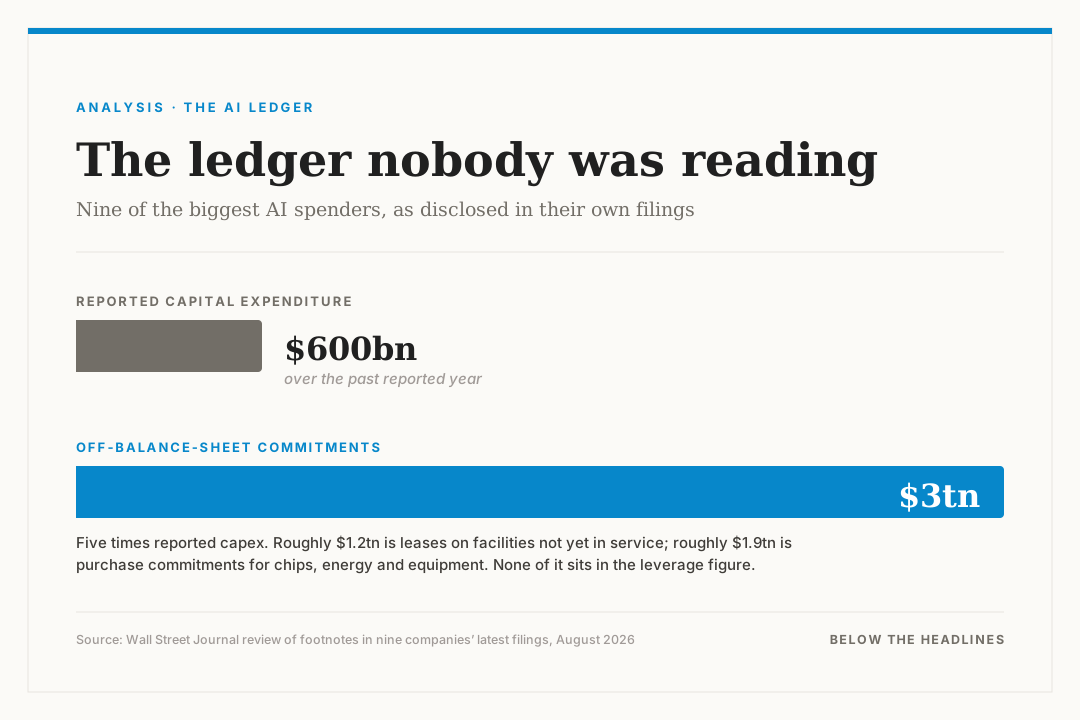
On this front the evidence has been moving toward him rather than away. A Wall Street Journal review of the footnotes in recent filings from nine companies, among them Alphabet, Amazon, Meta, Microsoft, Oracle, Nvidia and SpaceX, put their off-balance-sheet commitments at roughly $3 trillion. About $1.2 trillion of that is leases on facilities not yet in service; about $1.9 trillion is purchase commitments for chips, energy, and equipment. Reported capital expenditure over the comparable period was around $600 billion. Alphabet on its own disclosed $811 billion in purchase and contractual commitments as of 30 June, and Meta listed $347 billion in leases that have not yet started.
None of this is concealed. It sits in the footnotes, which is precisely the point Burry is making. Purchase commitments stay off the balance sheet until something is delivered, so a company can contract for the better part of a decade of capacity while showing very little of it in the leverage figures most investors actually read.
The circularity is easier to describe than to price. Nvidia invests in OpenAI; OpenAI signs compute contracts reported at $300 billion with Oracle, $38 billion with Amazon, and up to $22.4 billion with CoreWeave; those providers turn round and buy Nvidia hardware. Money leaves one balance sheet as an investment and arrives back on the same company’s income statement as revenue, having passed through two intermediaries on the way. Nvidia carried roughly $145 billion in supply commitments alongside its most recent quarter.
CoreWeave is where the leverage stops being abstract. It has raised about $18.8 billion in debt against $3.5 billion in equity, and its quarterly interest bill has reached $640 million, which annualises to more than the company earned in the whole of 2025.
Why two arguments keep arriving as one
A dispute about lease footnotes does not photograph well. The man who called the housing crash saying that AI is a fraud does. So the coverage settles into a pattern in which the weaker claim, testable and currently losing, supplies the headline, while the stronger claim, structural and slow, sits four paragraphs down or gets cut for length.
Burry’s own incentives live inside that pattern. He is not managing outside money any more; he is selling a subscription to the argument. That does not make the argument wrong, and the newsletter has produced more specific, checkable work than years of one-word warnings on social media ever did. It does mean the volume control and the revenue line now point in the same direction, and readers are entitled to notice.
The record he is arguing against
He knows how this looks. “I am now a meme for the number of times I have called a crash,” he has written; “I have become the boy who cried wolf.” Of roughly 14 high-profile calls between 2017 and 2023, most did not come good. In January 2023 he posted a single word, “Sell”, shortly before one of the strongest technology-led rallies on record; by 30 March he had written that he was wrong to say it.
His defence is that a structural diagnosis and a dated trade are different objects, and that shorting is a timing exercise even when the diagnosis holds. Both halves of that are true. Both were also true in 2005, when the mortgage thesis was correct and the position lost money for two years before it stopped losing money.
What would actually settle it
Burry describes the failure mode as a compression rather than a crash: demand softens, deferred costs finally land in the accounts, and financing turns expensive at roughly the same moment. Compression is harder to report than a collapse, because it arrives in ordinary quarterly language and no single day looks like the day it happened.
The signals worth following are unglamorous. A hyperscaler shortening its stated useful lives, as Amazon has already done, moves the depreciation question out of opinion and into disclosure. A lease commitment quietly renegotiated rather than commenced would suggest the $3 trillion is softer than it reads. Credit spreads on the neocloud operators will price the financing risk long before any equity index does, and CoreWeave’s interest bill remains the single cleanest number in the story.
For now the market is voting against him on volume. Morgan Stanley models around $800 billion of hyperscaler capital spending in 2026 and $1.2 trillion in 2027, against roughly $450 billion forecast a year earlier. Bank of America expects more than $1.2 trillion over the coming 12 months. Alphabet guided to between $195 billion and $205 billion for 2026 and lost 7.2 per cent in a week, which is a market repricing the return on the spending rather than the spending itself.
That distinction carries the whole story. A bubble bursting and a boom being repriced look identical for about six months, and they are told with the same photographs. Burry has bet on the first. What the evidence supports so far is closer to the second, with one caveat worth holding onto: the ledger that everybody is now arguing about was not visible to the public at all until a newspaper went and read the footnotes.
This is the layer below the headline.
Sources
Every figure in this piece traces back to a published document or report. Follow them.
- Michael Burry de-registers Scion Asset Management as he warns of market bubblesSherwood News
- Scion Asset Management bets against Nvidia and PalantirBarchart
- Short Thoughts, July 8 2026: NVDA, Neos, Hyperscalers, Jevons Paradox, and CompressionCassandra Unchained
- Burry says the AI buildout is repeating 2008: “The shenanigans are apparent today”24/7 Wall St.
- Big Tech’s AI bill is $3 trillion bigger than it looksThe Wall Street Journal, via Asharq Al-Awsat
- Nvidia A100 pricing, August 2026Thunder Compute
- A100, H100 and B200 rental prices rise as AI demand stays strongDigital Citizen
- Nvidia, CoreWeave and Nebius: inside the circular financing of the GPU boomI/O Fund
- Depreciation of GPUs: between useful lives and useful mythsDeep Quarry
- Michael Burry’s $39-a-month Substack hits 300,000 subscribersFortune, via Yahoo Finance
- Hyperscaler capex seen at $1.2 trillionBenzinga