In February, Forbes reported that staff at the AI video company Higgsfield had circulated folders of racist clips and non-consensual deepfakes made with their own product, that creators in its payout programme could not withdraw money, and that subscribers sold “unlimited” plans at a 65 per cent discount had been throttled until they bought credits. It was a good piece of reporting and it was treated as the story.
Six months later Higgsfield raised $400 million at a $5.4 billion valuation, led by DST Global with Goldman Sachs Alternatives and Intel Capital among the participants. Annualised revenue reached $700 million in August, against $20 million a year earlier. The valuation has quadrupled in eight months.
So the scandal was not the story. The structure was. And once you look at the structure, the interesting question is not what Higgsfield did. It is why the companies being sued over AI video are not the companies making money from it.
What Higgsfield actually sells
Higgsfield does not train video models. It resells them.
Its products run on ByteDance’s Seedance, Kuaishou’s Kling, MiniMax’s Hailuo, Google’s Veo and others, bundled behind one subscription starting at $15 a month, with a layer of camera controls and character-consistency tools on top. Its own comparison page recommends five models, all of them somebody else’s. Analysts describing the “signature camera tech” have called it a playlist of other people’s models: effects and transitions on Kling, camera moves on Hailuo. Buyers have noticed the arithmetic, with critics pointing out that Kling can be bought directly for roughly a quarter of what the reseller charges for the same output.
That is a legitimate business. Aggregation has value, and $700 million of annualised revenue suggests people will pay for convenience. But it means the company at the top of this market carries none of the thing that creates legal exposure in this market, which is training data.
The only serious lawsuits are about cartoon characters
There is real legal pressure on this industry, and it is pointed somewhere else entirely.
Disney, NBCUniversal and DreamWorks sued Midjourney last June over training on their films. The same studios, joined by Warner Bros. Discovery, sued MiniMax in September over Hailuo, and in May 2026 the court refused to dismiss, holding the claims plausible on both the training and the outputs. Runway faces a class action over YouTube data. Every one of those defendants builds models. Higgsfield, which resells them, has been sued once, by a customer, over refunds.
Money in one company, liability in another
The litigation stops one floor below the money. It is also litigating the wrong thing.
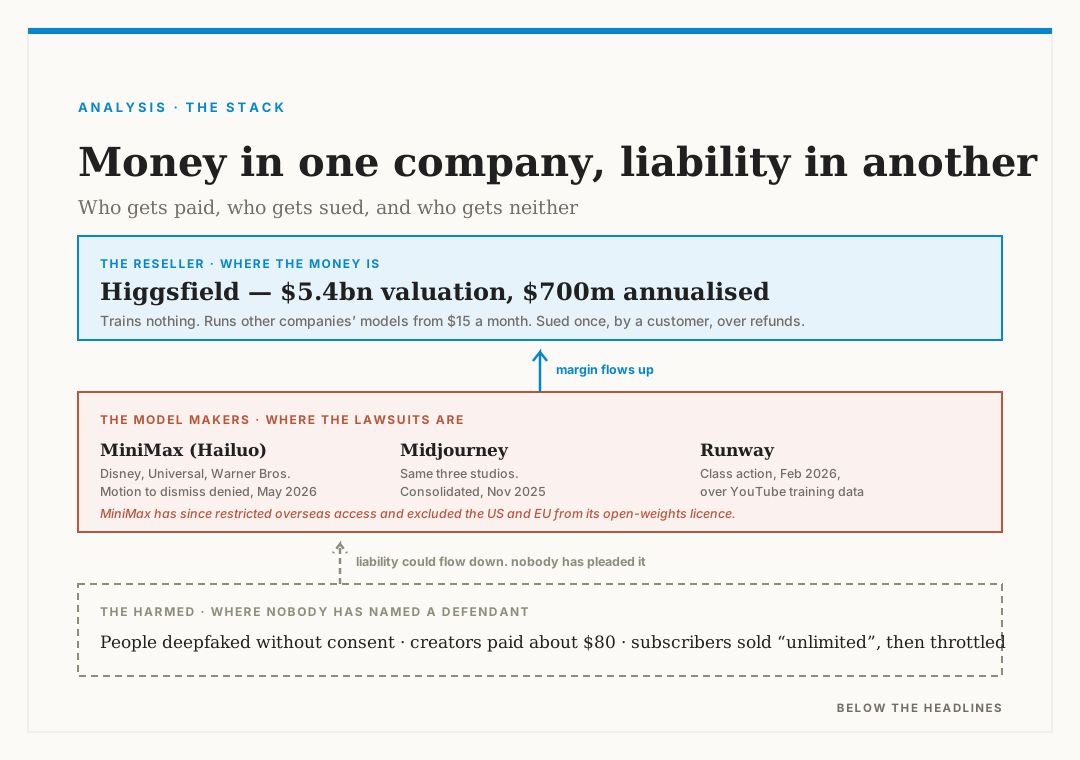
Because those cases are about who owns Mickey Mouse. Nothing in them touches the volume of unsolicited material the machine produces, or who gets paid to produce it. A total studio victory would rewrite the licensing terms of the supply chain and leave every incentive described in the rest of this article exactly where it is.
The distribution layer has the same shape
The pattern repeats one layer sideways, in the tooling that turns synthetic volume into customers, and it is worth looking at closely because the receipts are public.
Manychat raised $140 million from Summit Partners, is profitable, moves billions of messages a year and serves over a million businesses in more than 170 countries. Its Comment to DM feature is the mechanism behind every “comment LINK and I’ll send it over” post; its newer Follow to DM messages every new follower automatically and is an approved Meta integration. The company is emphatic that it is an official Meta partner working inside the Graph API, and that is true.
It is also operating right at the edge of the anti-spam limits. Meta permits 750 private-reply calls an hour for Instagram professional accounts, and Manychat throttles comment triggers to twelve per minute to stay inside that ceiling. Its own community forums carry thread after thread from users whose accounts were restricted or disabled: “MANYCHAT Got my Instagram account banned”, “Instagram Business Account Disabled Due to Automation”, “I’ve been BANNED from sending messages on Instagram”. The company’s answer is that such bans come from running unofficial bots alongside it, exceeding safe volumes, or tripping detection during setup, which is plausible and may usually be right. The structure is still the same one: the platform sets a spam threshold, a funded intermediary builds a business as close to that threshold as permission allows, and the account that gets disabled belongs to the customer.
What the reviews say when you read them in order
Two sets of public reviews tell a story the funding announcements do not.
On Trustpilot, across roughly 243 reviews, the recurring complaint is not the automation but the billing. Users describe being charged after cancelling, one reporting that they cancelled twice and were still invoiced on the fourteenth of every month, and describe difficulty obtaining refunds. Support is a consistent weak point, with reviewers reporting generic automated replies that blamed them for misreading the terms. G2 reviewers flag the same two things.
The mechanism underneath those complaints is the interesting part. Manychat bills per contact, and it counts every person who messages the account, whether or not that person ever triggered an automation. Exceed the allowance and the automations do not stop; overage is charged automatically. So the tool sold to help you farm inbound messages bills you for every inbound message it farms, and the growth it manufactures is also your cost base. There is no switch that turns the meter off, which is the same design decision as selling an unlimited plan and then throttling it.
Then, on 2 March this year, the pricing moved to contact-based tiers and the free plan went from 1,000 contacts to 25.
Free until it was load-bearing
A 97.5 per cent cut to the free tier, ten months after a $140 million raise at a company that was already profitable. Users report bills growing two to three times as their audiences grew.
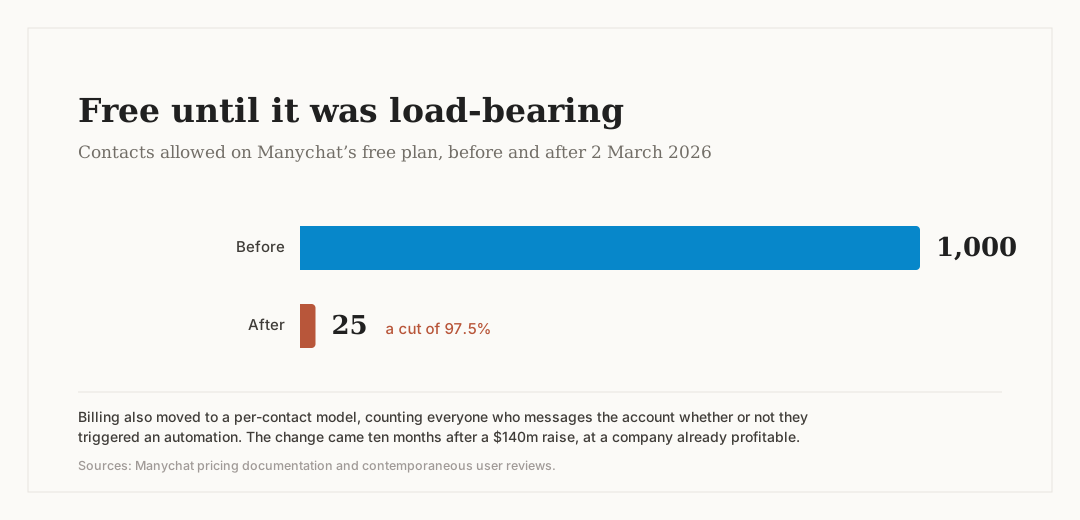
That is the enclosure pattern again, run on a schedule. Reddit and Google Maps both kept an interface cheap while they needed an ecosystem and repriced it once the dependency was load-bearing. Manychat took growth capital while profitable, then cut the entry tier by 97.5 per cent and moved everyone onto a meter that rises with audience size even when engagement does not.
Tobacco took forty years. Meta took twenty.
There is a precedent for what happens when an industry spends two decades pushing costs onto people outside the transaction, and it concluded in a courtroom in Oakland this month.
On 18 August, a coalition of state attorneys general opened trial against Meta in the consolidated proceeding known as MDL 3047, before Judge Yvonne Gonzalez Rogers, arguing that Instagram and Facebook had been engineered to addict minors and that the company had misrepresented what it knew. Eight days later Meta settled. The figure has been reported variously as $16.7 billion, $17 billion, $17.1 billion and up to $18 billion depending on how the ceiling is counted, payable in annual instalments over ten years, resolving the claims of 51 jurisdictions. Tennessee’s attorney general called it the largest Big Tech settlement in history. It funds an independent social media research foundation and installs an independent auditor to assess compliance for five years.
The comparison to tobacco is usually made as rhetoric. Here it is closer to a structural description. One analysis of the executed documents lists the matching features: a multistate attorney general action settled short of verdict, a decade of scheduled payments, restrictions on marketing and product design in place of any ban, an industry-participation trigger, and an independent monitor. That is the architecture of the 1998 Master Settlement Agreement, which bound the four largest tobacco companies to 46 states for at least $206 billion over its first 25 years.
The parallel has serious critics. The American Enterprise Institute argues the tobacco analogy is deceptively flawed, and the objection is not silly: cigarettes have no safe dose and no beneficial use, which is not true of a messaging app. But the mechanism being litigated is the same one this article has been tracing. The engagement-maximising algorithm, the infinite scroll, the notification cadence: these are not incidental features that harmed people by accident. They are the revenue model, because advertising income depends on time on platform.
What the Meta settlement demonstrates is that externalised harm is not permanently external. It is unpriced until somebody with subpoena power prices it. Tobacco took roughly forty years from the first internal research to the MSA. Meta took about twenty from founding to settlement. The AI video layer is two years old.
The company that certifies the tools just paid the bill
Now put the two halves of this article next to each other, because they meet in one place.
Manychat’s Follow to DM, the feature that automatically messages every new follower, is an approved Meta integration. Comment to DM runs on Meta’s Graph API within limits Meta sets. Meta certifies, rate-limits and profits from the layer that industrialises engagement farming on its own surfaces.
Meta has just paid up to $18 billion to settle claims that it engineered engagement in ways that harmed children. Nothing in that settlement, as reported, reaches its automation partners. The reforms concern minors on Meta’s own products. The approved integrations that exist specifically to maximise unsolicited contact are not party to it, and the businesses paying monthly for them carry the account bans when the thresholds are crossed.
A defendant that has just been priced for engineering engagement is still licensing engagement engineering to everybody else, and the bill for that has not been drawn up by anyone.
What all of it adds up to
Step back far enough and the separate companies in this article stop looking like separate companies.
Chinese labs generate a video clip for somewhere between twenty and fifty cents. A reseller worth $5.4 billion bundles those models behind a $15 subscription and pays creators about $80 each to flood the feeds with the output. A Meta-approved automation tool converts the resulting traffic into direct messages and bills its own customer for every contact it produces, automatically, with no way to switch the meter off. Meta ranks the result, sells advertising against the attention it generates, and has just paid up to $18 billion for what engineered engagement did to children. Every layer is paid by the unit of contact manufactured. Every layer has arranged for something else to hold the harm.
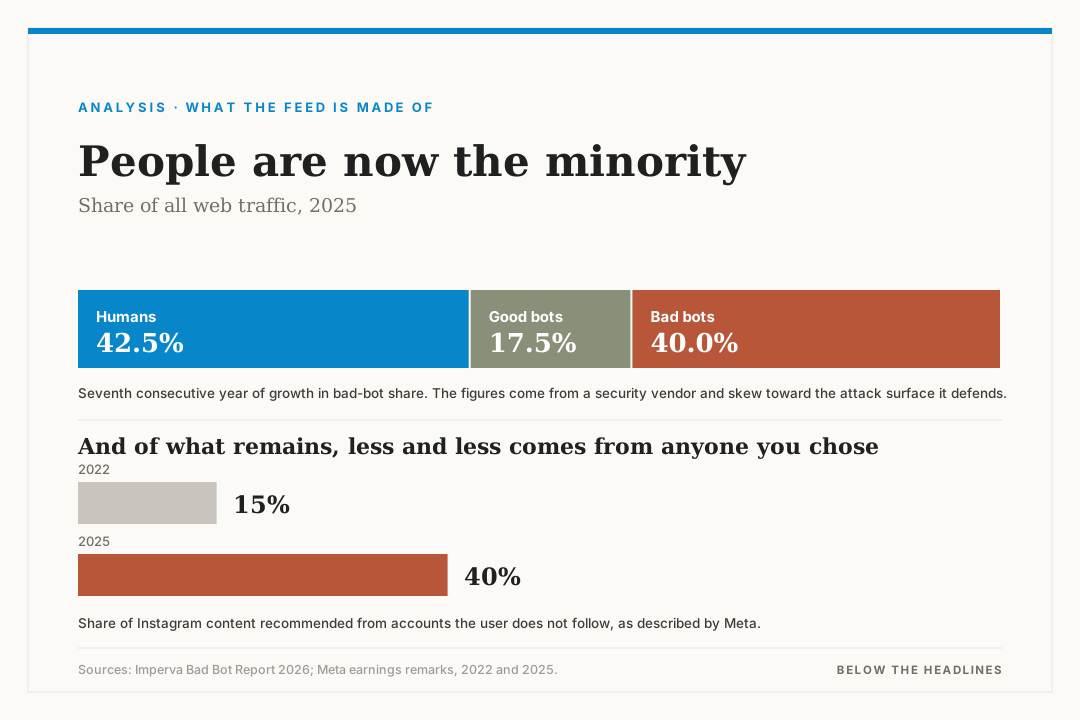
The output of that machine is now measurable, and it is not marginal. Automated traffic passed half the web: bots account for more than 53 per cent of it, bad bots alone for 40 per cent, and human beings for 42.5 per cent, the seventh consecutive year in which the machine share has grown. Fifty-nine per cent of the videos served to a new TikTok account read as AI slop. Around a fifth of YouTube recommendations are synthetic. And roughly 40 per cent of what Instagram shows now comes from accounts the user never chose to follow, against about 15 per cent in 2022, with Meta openly describing plans for an effectively infinite AI-generated feed on top of that.
The cost of consuming it is measurable too. The global average is about two hours twenty minutes a day. American teenagers pass three hours; some of Gen Z reach five. TikTok alone takes an hour and eighteen minutes a day from American teenagers.
Above three hours a day, adolescents show roughly double the rate of depression and anxiety symptoms. The direction of causation is still genuinely contested and it would be dishonest to pretend otherwise, since unhappy teenagers also reach for their phones more. But one number sidesteps the argument entirely: 48 per cent of American teenagers now say social media is mostly negative for people their age, up 16 points in four years. That is not researchers inferring harm. That is the users filing a review.
What is actually good about it
There is a real product buried in this and it deserves saying plainly, because the argument is worthless without it.
Knowing that a friend had a baby. Seeing what someone you like is cooking, reading, arguing about. Sending a photograph to twelve people at once instead of twelve times. Finding the other four people in your country with your condition, your instrument, your obscure problem. That is genuine, it is why anybody joined, and no volume of slop erases it.
The difficulty is that it has become the residual. If two-fifths of Instagram now comes from accounts you did not choose, and advertising sits on top of that, and much of the remainder is synthetic, then the thing people actually signed up for is a minority of what is delivered to them. The valuable part is the exception now, and it is shrinking by design, for a reason that is entirely structural rather than sinister: contact from people you already know does not scale, cannot be expanded on demand, and cannot be sold by the unit. Manufactured contact can be. So the machine grows the part that can be metered and lets the other part thin out.
Why the usual fixes will not touch it
Almost every remedy currently on the table operates on the output. Labels on synthetic media. Age verification. Forty-eight hour takedown windows. Moderation headcount. Each is worth having and none of them reaches the mechanism, because the output is infinite by construction and the revenue is the volume.
The Meta settlement is instructive precisely because it did not work that way. It did not ban a product or filter a feed. It attached a price to an externality that had been free for twenty years, in the only language the balance sheet reads. The 1998 tobacco settlement worked the same way and did not ban a single cigarette.
There is one disclosure that would make the argument unavoidable. Meta already reports the share of a feed arriving from accounts a user does not follow, because rising unconnected content reads as growth to investors. Inverted, that same figure is the only honest measure of whether a social network is still a social network, and nobody publishes it that way.
So the change that would matter is not more moderation. It is that the unit stops paying. As long as a reseller is paid per generation, an automation tool is paid per contact, and a platform is paid per impression, every participant is correctly incentivised to manufacture more of exactly what everyone says they do not want. Nothing in the $18 billion Meta settlement touches that layer. The layer just raised $400 million.
This is the layer below the headline.
Sources
Every figure in this piece traces back to a published document or report. Follow them.
- Racist Videos And Payment Problems: The Dark Side Of This AI Startup’s Super-Fast GrowthForbes — Rashi Shrivastava, 11 February 2026
- Higgsfield raises $400M Series B, quadrupling its valuation in 8 months to $5.4BTechCrunch, 17 August 2026
- Manychat raises $140M led by Summit PartnersSummit Partners
- Is Instagram DM automation safe? Manychat, bans and the official APICreator Lane
- Manychat customer reviewsTrustpilot
- Manychat employee reviewsGlassdoor
- Manychat review 2026: strong automation, weak AI, rising pricesFlowgent
- Manychat pricing trap: when growth costs you moreCreatorflow
- Meta reaches $17 billion settlement with states in landmark trial over teen social media addictionPBS NewsHour
- Meta settles social media addiction case with California and other statesCNBC
- Meta’s teen settlement borrows tobacco’s structure and tobacco’s flawsPPC Land
- Social media addiction lawsuits: the deceptively flawed tobacco analogyAmerican Enterprise Institute
- Tobacco Master Settlement AgreementReference entry
- Bad Bot Report 2026: bots in the agentic ageImperva
- The AI behind unconnected content recommendations on Facebook and InstagramMeta AI
- Social media and youth mental health: advisoryUS Department of Health and Human Services
- Social media and mental health statistics, 2026SingleCare
- Teen social media statistics 2026: usage, screen time and mental healthAxis Intelligence