If you’re on a ManyChat paid plan and a post takes off, here is what happens to your bill. Your contact count sails past the plan limit, and nothing stops. The automations keep running, every new person who messages you gets counted, and each one costs you somewhere between about $0.004 and $0.10 depending on your tier. There’s no spend cap and no message asking whether you’d like to keep going; you find out when the invoice lands.
That’s how a Reel that finally lands turns into the most expensive month you’ve had. And the billing doesn’t get any friendlier on the way out. Trustpilot is full of people describing charges that arrived after they’d cancelled, then weeks of back-and-forth to get the money returned. People have been asking for a spend cap for four years. It’s a couple of days of engineering that wouldn’t touch the pricing model at all, only the surprise, and it still hasn’t shipped.
Call it what it is. A billing design that only works while you don’t understand it is a scam in the everyday sense of the word, whatever a lawyer would call it.
The easy explanation is greed, and greed is actually the kind version. A greedy company ships the cap and then raises the price, because you’ll pay more for a plan when you can see where the ceiling is. Confident companies don’t bill their own customers by ambush. Uncapped billing is what you do when you need money from people who never agreed to spend it, and the other ways of getting it have stopped working.
The thing you’re paying for is now free
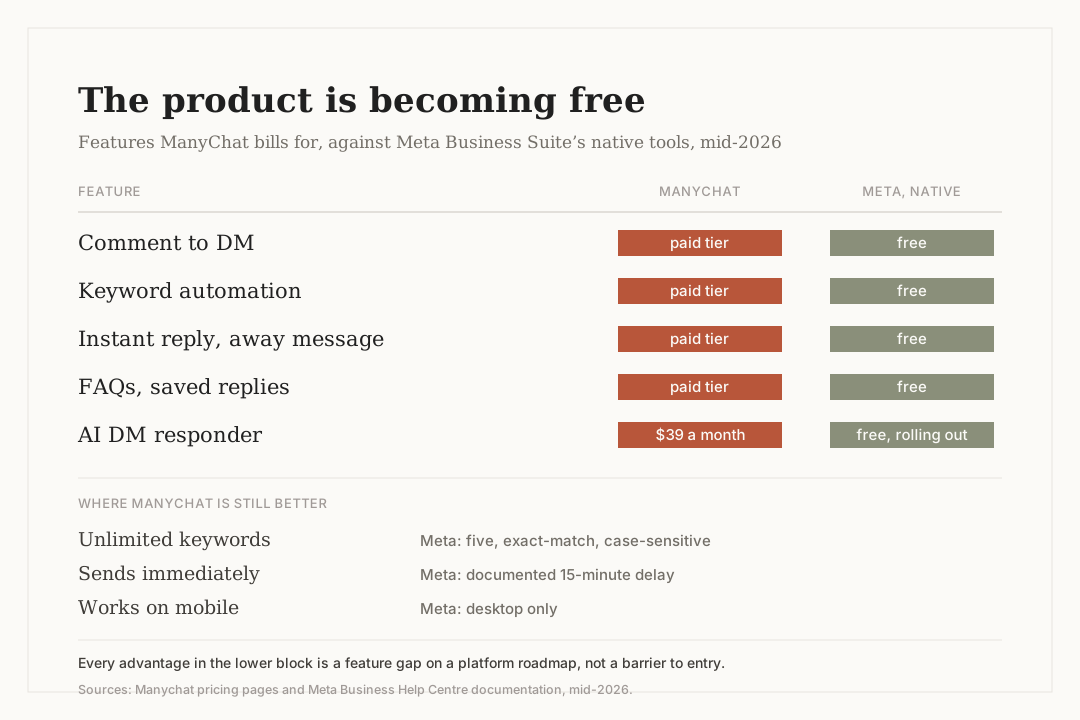
Open Meta Business Suite and look at the automation menu. Six tools, no charge: FAQs, Saved Replies, Instant Reply, Away Message, Custom Keywords and Comment to Message. That last one is comment-to-DM, the feature most of you signed up for. Keyword triggers are in there too. A lot of the guides you’ll find still insist Meta offers neither, which was true a while ago and isn’t any more. If that’s why you’re paying a subscription, you’re paying for something you already have.
To be fair, Meta’s version is clunkier. You get five keywords per automation, exact-match and case-sensitive, there’s a documented 15-minute delay before anything sends, and you can only set it up on desktop. But every one of those is a gap Meta can close whenever it likes, and it’s closing them. A free AI responder called AI Auto Replies is rolling out to creators in stages, with a Business Agent behind it.
Which must be a difficult thing to look at from inside ManyChat. The company raised $140 million to build agentic AI. What shipped is an AI step that reviewers say behaves more like keyword matching than conversation, and it sits behind the $39 a month tier. Meta’s is better, and Meta’s is free.
There was never a moat
Strip the branding off and ManyChat is a friendly interface sitting on top of Meta’s Graph API. The Meta partner badge that gets described as a moat is a licence, and licences get handed out: CreatorFlow became a Meta-Approved Tech Provider in January 2026 and others have followed since. The template library isn’t defensible either. In 2026, a drag-and-drop flow builder is a weekend project.
The one thing that genuinely keeps you there is that your contacts export and your flows don’t. Leave, and you rebuild every sequence from scratch. That’s a hostage arrangement dressed up as a product advantage, and hostages do eventually leave. The companies relying on that know it better than anyone.
The clock ManyChat is on
In April 2025, ManyChat raised $140 million in a round led by Summit Partners, bringing total funding to $163.3 million since the company started in 2015. Its first institutional money was $18 million from Bessemer in 2019. So: $18 million across the first decade, and $140 million in the last year.
And when the round was announced, ManyChat said it was already profitable.
That detail matters more than it sounds. A profitable company growing 55 per cent a year doesn’t take a nine-figure growth equity round because it needs cash. It takes one because the founders and early investors want some money out, or because a new investor wants a board seat and a timeline. Growth equity isn’t venture capital under a different name; it comes with a deadline, usually four to six years.
Then they hired. Headcount went from 386 to 547 between 2025 and 2026, a little over 40 per cent, after the money landed.
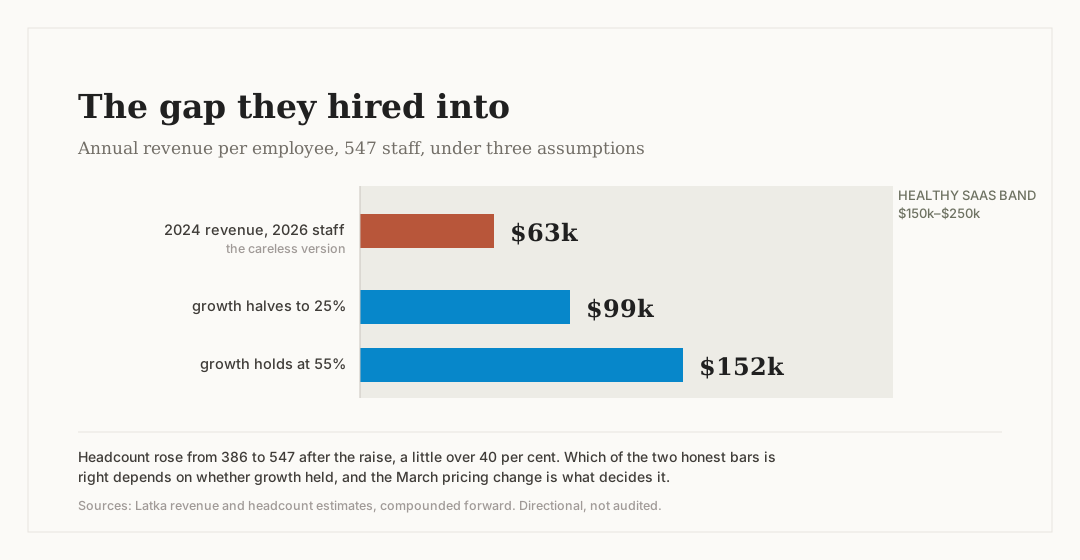
The arithmetic needs care from this point, because the sloppy version is everywhere online and it’s wrong. Divide 2024 revenue by 2026 headcount and you get about $63,000 per employee, which looks catastrophic and means nothing, since it sets an old number against a new one. Do it properly and roll the revenue forward. If 55 per cent growth held for both years, 2026 revenue lands near $83 million, which works out to roughly $152,000 per employee across 547 people and sits at the low end of normal. If growth halved to 25 per cent, revenue is nearer $54 million and the figure drops to about $99,000. Healthy software companies run $150,000 to $250,000 a head, and up.
The gap they hired into
Which of the two honest bars is right can’t be settled from outside. What’s certain is that they hired ahead of the revenue, and something has to close that gap. You’re that something.
Ten months after the round, on 2 March 2026, the free plan dropped from 1,000 contacts to 25. Four automations, and that’s your lot. Latka estimates ManyChat made about $34.6 million in annual recurring revenue in 2024 across more than a million customers, which comes out to roughly $35 per customer per year. Most of that million were on the free plan, paying nothing and costing something to serve. Cutting free by 97.5 per cent is the fastest way to lift recurring revenue without spending a cent on marketing, and just about the only lever that moves fast enough for an investor’s timeline.
Line the four facts up: no moat, a core feature the platform is quietly giving away, a team 40 per cent bigger than the revenue supports, and a deadline. There’s exactly one place left to find the money, and it’s the wallet of a customer who’s already inside the building. That’s you.
The free tier cut and the uncapped meter aren’t two decisions. They’re the same decision, made twice.
Everyone’s arguing about the wrong thing
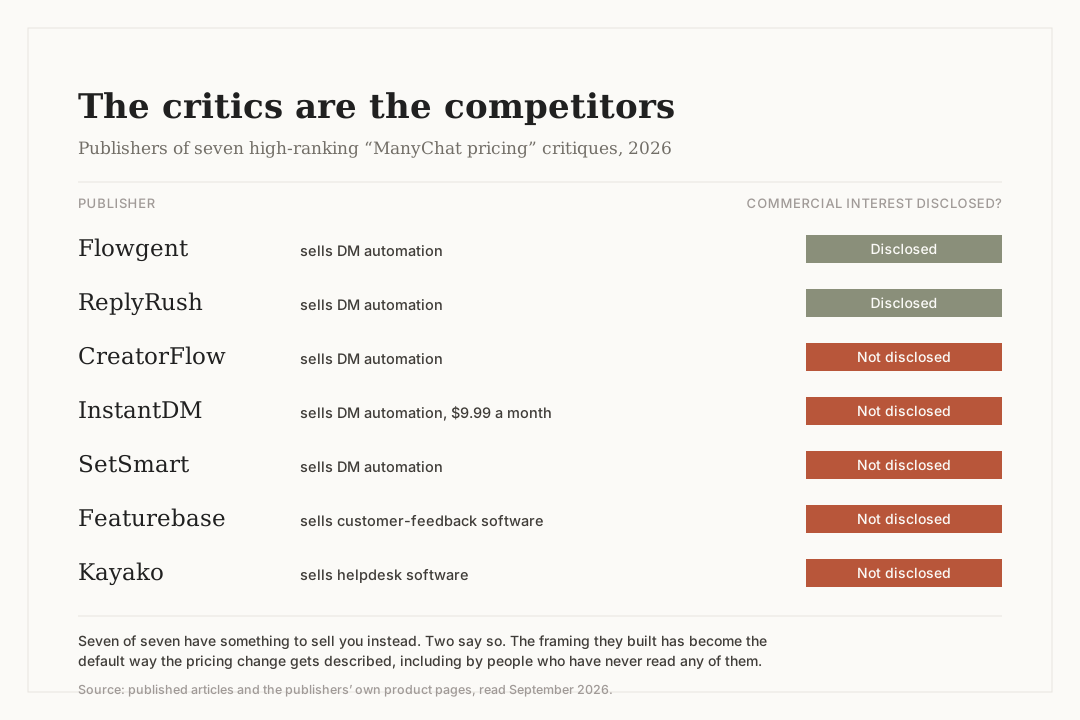
Search “ManyChat pricing” and you’ll hit a wall of takedowns, most of them angry and most of them well written. Nearly every one comes from a company that sells a ManyChat alternative: Flowgent, ReplyRush, CreatorFlow, InstantDM, SetSmart, Featurebase, Kayako. Two of them tell you that in the first paragraph. The rest don’t mention it at all.
The critics are the competitors
Seven of seven have something to sell you instead. The framing they built is now the default way the pricing change gets talked about, including by people who’ve never read any of them.
There’s nothing sinister about it. That’s just what SEO looks like when you’re the smaller company and the market leader’s name is the biggest keyword in your category. But it has warped the conversation. Every one of those posts frames this as a pricing dispute, because a pricing dispute is the story that ends with you switching to their product. So the whole internet is busy arguing about whether $39 a month is fair.
It’s the wrong argument. The price was never the problem. A company that could defend its position would charge more, not less, and it would ship the spend cap tomorrow, because a cap is a trust feature and trust is what you sell when you’re winning. The overcharging is a symptom. The vendors who built this conversation have no reason to say that, because the same diagnosis applies to them.
Look at who’s coming in underneath. InstantDM at $9.99 a month, Inrō, CreatorFlow, ReplyRush, SetSmart. Each one is the same thin layer on the same Meta API with a friendlier price and a blog post about how per-contact billing punishes success. None of them has a moat either. They’ll grind each other down on price, because price is the only thing any of them controls, and the whole category is one Meta product update away from becoming a toggle in your settings.
What probably happens next
The most likely ending is a sale, not a collapse and not a competitor. To be clear, no deal has been announced and nothing here suggests one is under way. This is what the funding structure implies about where things are headed.
Two clocks are running, and the older one gets less attention. Summit’s money arrived in April 2025 on a four to six year horizon, which points somewhere around 2029. Bessemer’s $18 million went in back in 2019, and a fund that’s held a position for seven years is well into the period where its own investors start asking when it turns into cash. The pressure for an exit doesn’t start with the newest backer. It starts with the oldest.
And what’s actually being sold in that deal is the growth rate. A company making $54 million and growing 25 per cent and one making $54 million and growing 55 per cent look identical on the income statement and completely different at the negotiating table, because the valuation attaches to the slope, not the level. Seen that way, the March pricing change reads differently. Charging the people already inside the product is the cheapest way to keep the line steep for the handful of quarters a buyer will actually examine, and it costs nothing in marketing, which matters a great deal to a company that has to show growth and profit at the same time.
Everyone with equity is paid on that exit price, and that includes the people making the pricing decisions. Founders, early staff and both funds score every choice between now and the sale against the same number. And the number has a floor. Summit needs to sell for more than it paid in April 2025, when the pitch was AI-driven customer engagement and Meta hadn’t shipped a single native automation tool. The valuation was set when the story was at its best. The exit has to clear it after the story got worse.
Which raises the question none of the pricing arguments ask: what is a thin layer on someone else’s API actually worth to a buyer, once the platform gives the core feature away and hands the partner licence to anyone who applies? Not the technology; a flow builder is a weekend project. What’s left is a million accounts, a brand creators recognise, a channel into them, and a partner badge that now comes with company. That’s a distribution asset, not a software asset. A strategic buyer would pay for the customer list and sell its own products through it. A private equity buyer would price it as cash flow with a shrinking tail and run it that way, which looks a lot like what’s already happening. Either way, the price drops every quarter Meta’s AI Auto Replies gets closer to reaching everyone. So the squeeze is a race: show the number before the window closes, without pushing so hard that the customers a buyer is paying for leave first.
There’s a catch, though. To sell the company, ManyChat has to show a buyer that customers stick around, and the customers a buyer cares about most are the ones whose audiences are growing. They’re the success stories, the accounts that keep upgrading. And they’re exactly who an uncapped meter hits hardest, because a growing audience is what pushes you past the limit in the first place. So the surprise fee lands on the customers ManyChat can least afford to lose, and every one who leaves angry takes a slice of the sale price with them.
This is also why those Trustpilot reviews matter, and for a colder reason than you’d think. Charges after cancellation and refunds that take weeks turn into a revenue-quality question in a data room. Money a customer disputes gets discounted, carved out of the valuation, or held in escrow against future claims. A meter that generates complaints is generating revenue a buyer will pay less for.
So the things to watch are small and unglamorous. A spend cap appearing would mean retention has started to matter more than the next four quarters. A move away from per-contact pricing, to per-seat or usage with a ceiling, would mean someone is cleaning the revenue up for a buyer. And Meta pushing AI Auto Replies past its staged rollout would shorten whatever window is left, because the pitch to any buyer depends on this layer still being worth owning.
Whatever’s left of the brand in 2029 becomes the buyer’s problem. From the inside, that’s the correct play for the position they’re in, and somebody at ManyChat has already done this maths and reached the same conclusion.
It does mean your relationship with them has stopped being a relationship. Nobody builds a spend cap for a customer they only plan to keep for another eighteen months.
Which is the part that actually affects you. A roadmap tuned for revenue per user between now and an exit isn’t tuned for you. So export your contacts on a schedule, keep a written copy of every flow you couldn’t rebuild in an afternoon, and check what Meta’s free tools already cover before your next renewal. Then price your own business on the assumption that this line item goes up again before it comes down.
A hypothetical: three ways the sale could price
This section is a thought experiment, and it’s labelled as one for a reason. ManyChat never disclosed the valuation on the Summit round, so nobody outside the company knows the number a sale has to beat. What can be done is to build the range from things that are public. The two 2026 revenue cases come from earlier in this piece, $54 million if growth halved and $83 million if it held. The multiples come from two published 2026 datasets: Aventis Advisors puts the median private SaaS deal at 3.1 times revenue as of March, across 543 transactions, against a long-run median of 4.5; L40’s August lens runs from 2 to 3 times for below-market businesses up to 7 to 9 times for the top tier. And the floor is inferred. A $140 million growth-equity cheque usually buys somewhere between a fifth and a third of a company, which would put the post-money valuation between roughly $400 million and $700 million. One more mechanic matters: growth equity almost always carries a 1x liquidation preference, meaning Summit’s $140 million comes out of any sale first, before founders and staff see anything.
Scenario A: growth holds and a buyer pays for the story. Revenue reaches $83 million, a strategic acquirer wants the million-account channel and is willing to price the AI narrative at 6 to 7 times, just under L40’s top tier. That implies $498 million to $581 million. It clears the inferred floor, but only at the floor’s low end, and it needs two things to be true at once: the 55 per cent growth rate survives the pricing change, and Meta’s free responder hasn’t reached general availability by the time the deal is signed. Summit takes its $140 million and a healthy multiple on top. Founders and early staff do well. Customers get a new owner with a reason to keep investing, which is the one outcome where the spend cap might finally ship.
Scenario B: priced as what it is. A buyer looks past the AI pitch and pays for a customer list and a brand, at the 2026 median of 3.1 to 4.5 times. On $83 million that’s $257 million to $374 million; on $54 million it’s $167 million to $243 million. Every version of this lands below the inferred floor. Summit still gets its $140 million back first, so the fund is roughly whole to modestly up. The people who lose are the ones holding common stock, whose share is what’s left after the preference, and the loss is steepest in the $54 million case, where the founders’ outcome shrinks to a few tens of millions across everyone. This is the scenario the current pricing behaviour is trying hardest to avoid, and the one the arithmetic says is most likely.
Scenario C: the window closes first. Meta ships AI Auto Replies to everyone, the partner licence is in a dozen competitors’ hands, growth stalls, and what’s for sale is a shrinking base on a commoditised layer. L40’s below-market band is 2 to 3 times; on $54 million that’s $108 million to $162 million. Summit’s preference absorbs almost all of it. Founders and staff get little or nothing. And customers get the worst version of a private equity outcome without the private equity: a product frozen where it stands, priced to harvest, with no reason for anyone to build the cap because there is no future relationship to protect.
Three ways the sale could price
Only scenario A reaches the floor, and only at its low end. Everything left of the dashed line belongs to Summit before anyone else is paid.
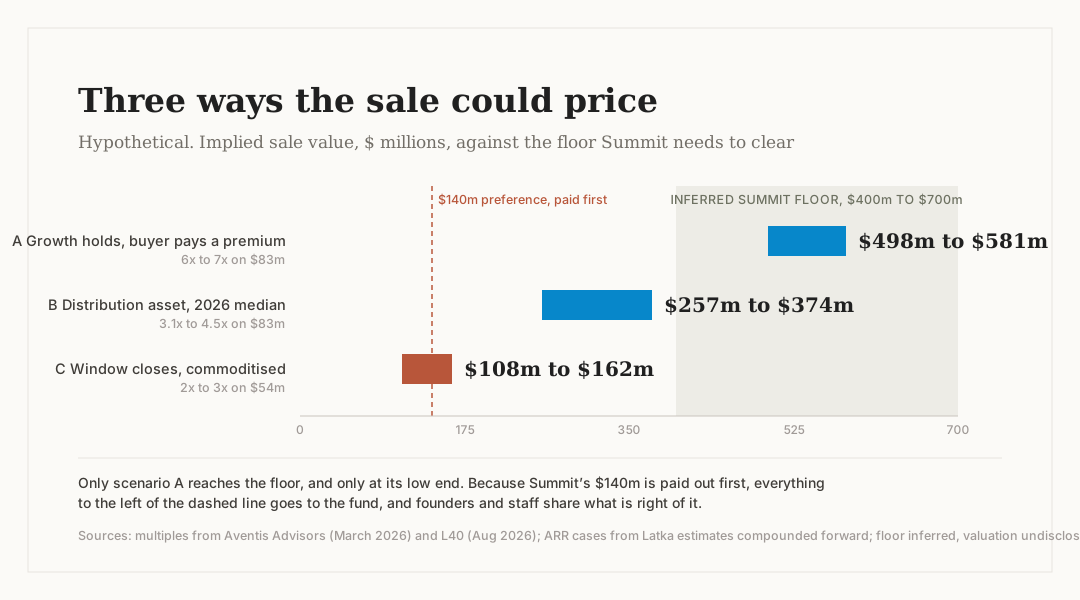
Read the three together and the pricing behaviour stops looking like a choice. Only one scenario clears the floor, it needs the growth rate to hold, and holding the growth rate is exactly what charging the installed base is for. Every quarter that passes moves the outcome from A toward B, and Meta’s rollout moves it from B toward C. Whether any of this is what ManyChat’s board sees is unknowable. But the numbers a rational board would be looking at are these, or something close to them, and they explain the uncapped meter better than greed does.
The uncomfortable part
None of this requires anyone at ManyChat to be a villain. Squeezing customers is what a weak position produces under a deadline, and it happens inside companies full of ordinary people who’d each describe their own decision as reasonable. Don’t look at intent. Look at the feature that would take two days to build and would cost them revenue, and notice it still isn’t there.
And the creators shouting loudest about all this have exactly the same problem one floor up. A business built on somebody else’s free plan, monetising somebody else’s audience, on a platform that quietly changed its marketing message window in February 2026 without asking anyone. That was never quite a business. It was a rental on unusually good terms, and the terms have changed.
Build on rails you don’t own and your margin is somebody else’s decision. ManyChat is just further down that track than the people currently shouting at it.
A note on the figures. Funding details come from Summit Partners’ April 2025 announcement. Revenue and headcount are Latka estimates built from public sources and proprietary models, so treat them as directional rather than audited. Pricing, overage rates and Meta’s native feature details come from ManyChat’s and Meta’s own published documentation as of mid-2026. The valuation section is explicitly hypothetical: the Summit round’s valuation and stake were never disclosed, the floor is inferred from typical growth-equity terms, and the multiples are published 2026 market medians applied to estimated revenue, not to ManyChat’s actual accounts. Calling the uncapped meter a scam is this publication’s judgement about a design choice, not an allegation of unlawful conduct.
This is the layer below the headline.
Sources
Every figure in this piece traces back to a published document or report. Follow them.
- Manychat raises $140M led by Summit PartnersSummit Partners
- Manychat revenue, headcount and customer estimatesLatka
- Manychat pricingManychat
- Manychat customer reviewsTrustpilot
- Automate replies and comments in Meta Business SuiteMeta Business Help Centre
- Manychat review 2026: strong automation, weak AI, rising pricesFlowgent
- Manychat pricing trap: when growth costs you moreCreatorflow
- Manychat raises $140 million in funding round led by Summit PartnersBloomberg
- SaaS valuation multiples, 2015 to 2026Aventis Advisors
- SaaS multiples 2026: the real private rangeL40