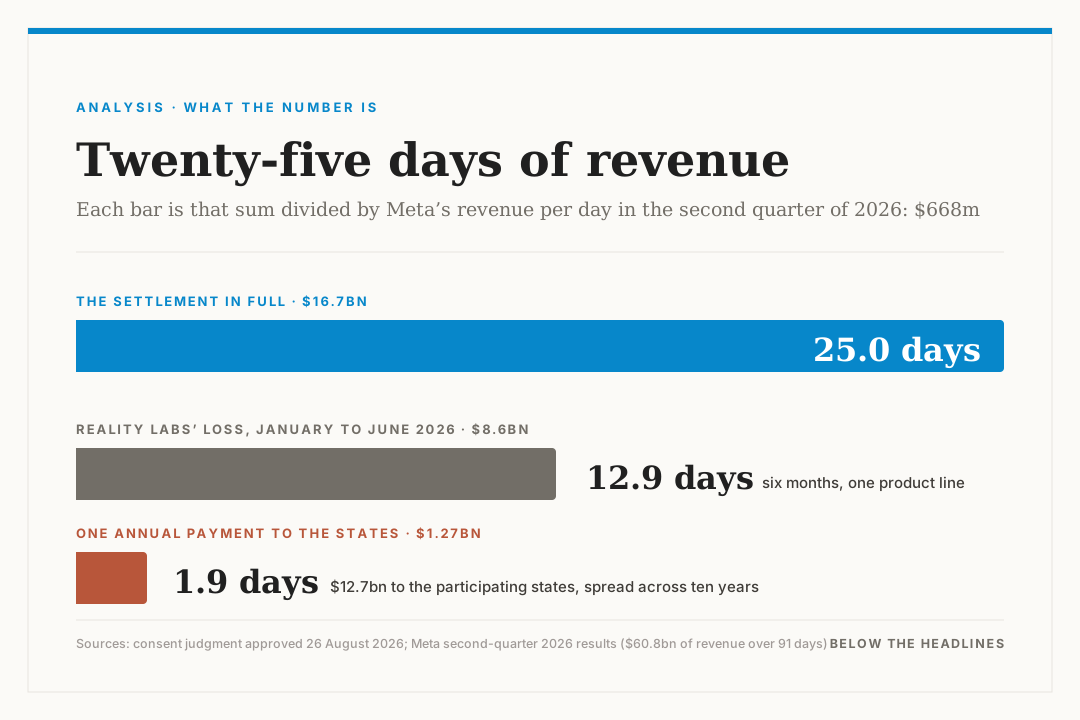
Meta took $60.8 billion in revenue in the second quarter of this year, which works out at about $668 million a day. The settlement it signed with a bipartisan group of 51 attorneys general on 26 August comes to $16.7 billion. That is 25 days. Florida’s attorney general, James Uthmeier, who kept his state out of the deal and is still suing, dismissed it as “a few weeks of revenue”. He was not reaching for a figure of speech. He was accurate to within about four days.
The arithmetic is why the coverage fell so quickly into a familiar shape: enormous number, enormous company, the 1998 tobacco settlement, and an argument about whether the old playbook still works on this industry. What that shape leaves out is that the payment was the least consequential term in the agreement. The stock market worked this out by lunchtime.
Three numbers for one settlement
The court filing says $16.7 billion. Several attorneys general announced $17.1 billion, which is the same deal plus more than $459 million settling Cambridge Analytica claims dating to 2018. Meta’s own statement says “approximately $18 billion”, distributed in annual instalments over ten years. Nobody is being dishonest. Three parties are counting three different things: the judgment, the judgment plus an unrelated leftover, and the undiscounted sum Meta expects to hand over between now and 2036.
The number that matters least is the one everybody printed. Participating states receive $12.7 billion of that total, spread across a decade. Call it $1.27 billion a year, which at the current run rate is 1.9 days of revenue. Texas, which stayed out of the group and cut its own deal, took $1 billion on its own, and a state with about a tenth of the country’s population walked away with something close to a tenth of everyone else’s decade.
The accounting runs on a different clock from the cash. Meta said it expects to book about $10 billion of legal expense in the third quarter, none of which it had previously provided for. Investors already saw a preview of that in the second quarter, when legal charges and severance turned what would have been a 9 per cent rise in operating income into an 8 per cent fall.
Set against what the company was facing, the size looks different again. Meta’s own attorneys had warned the court that a loss could produce damages as high as $1.4 trillion. Lawyers for the states put $200 billion forward as the realistic figure. The settlement is roughly 8 per cent of the number the plaintiffs themselves floated, and a bit over 1 per cent of the catastrophe Meta described. The company is worth about $1.5 trillion.
The 30 per cent that Google and TikTok have to pay
Here is the term almost nobody reported. Of Meta’s approximately $18 billion, the states get $12.7 billion, or 70 per cent, unconditionally. The remaining $5.3 billion arrives only if YouTube and TikTok adopt their own daily time limits, age-assurance measures and night modes, and pay a matching amount, with half of the outstanding money tied to YouTube and half to TikTok.
Read that as an incentive structure rather than a payment schedule. Fifty-one attorneys general now have $5.3 billion riding on Meta’s two largest competitors for teenage attention agreeing to be regulated on terms Meta has already accepted. That is a settlement which also hands the people suing you a direct financial stake in how hard they press your rivals.
The market priced this within hours. Snap, which is not party to the deal but sits squarely inside the same campaign, fell more than 8 per cent. Meta rose about 1 per cent by early afternoon, on the day it agreed to the largest consumer settlement in the industry’s history.
It’s a floor conceptually, not a ceiling.
What became of the settlement everyone keeps invoking
Mike Moore, the former Mississippi attorney general who led the tobacco litigation and is now drafting language for a social media master settlement, is the reason the comparison is everywhere this week. It is worth being precise about what his settlement did, because the useful lessons are not the ones usually quoted.
The 1998 Master Settlement Agreement bound four cigarette manufacturers and 46 states to $206 billion across the first 25 years, with payments continuing indefinitely after that. By the middle of the 2010s, states were collecting roughly $26 billion a year in settlement money and tobacco taxes combined, and spending about $470 million of it on prevention and cessation. Under two cents in the dollar. Attorneys general negotiated the money; legislatures decided where it went, and it mostly went into general funds.
The structural flaw was subtler and worse. MSA payments scale with the number of cigarettes sold, so states became creditors of an industry whose decline would shrink their receipts. More than 20 states and territories then securitised those future payments into tobacco bonds, roughly $40 billion of them, which handed bondholders a direct financial interest in Americans continuing to smoke.
What did cut smoking was price. Kip Viscusi’s reading of the agreement is that the payments functioned as an excise tax equivalent, passed through at the till; US consumption fell about 6.5 per cent in 1999, mostly on the back of the price rise the settlement caused. The remedy worked, and smokers paid for it.
Meta’s deal avoids two of those traps. The sum is fixed rather than volume-linked, so no state treasury has any reason to want teenagers on Instagram. It runs ten years, not forever. The money is earmarked for youth online safety work, although how a legislature actually spends earmarked money is the same open question it was in 1999.
The pass-through problem is where the analogy breaks entirely. A cigarette company can put the settlement on the price of a pack. Meta cannot bill the harmed party, because the harmed party is not the customer; advertisers are, and Advantage+ alone is running at more than $75 billion a year. So the cost lands on a balance sheet that is already stretched thin by something else. Free cash flow in the second quarter was $784 million, down from $8.55 billion a year earlier. Meta issued $24.9 billion of new long-term debt in the same three months and has bought back no stock at all this year, against $22.9 billion in the first half of 2025.
The question the trial never got to
The case ended eight days after opening arguments. Adam Mosseri was the only senior executive to testify; Zuckerberg was on the schedule and never took the stand. Meta admitted no liability, and both sides waived every right of appeal.
Which means the causal question at the heart of the lawsuit was never adjudicated. That is not a technicality. The scientific argument is genuinely unsettled, and the two strongest bodies of evidence point in different directions.
The best study the plaintiffs had
Facebook reached American colleges one campus at a time between February 2004 and September 2006, and that staggered rollout is as close to a randomised trial of social media as anyone will get. Braghieri, Levy and Makarin used it, matching the expansion dates against a long-running student health survey, and published the result in the American Economic Review in 2022.
Arrival of Facebook at a college worsened an index of student mental health by 0.085 standard deviations, which the authors benchmark at about 22 per cent of the effect of losing your job. Two percentage points more students crossed the threshold their model uses for depression, a 9 per cent increase on a baseline of 25 per cent, and for generalised anxiety, a 12 per cent increase on a baseline of 16. The mechanism they find is unglamorous and convincing: unfavourable social comparison.
Their most quotable line is also their most heavily caveated. On assumptions they list themselves, Facebook accounts for roughly 24 per cent of the rise in severe depression among American college students between 2000 and 2019. The caveats are that usage rates held steady after 2005, that the effect never changed, and that it does not accumulate. None of those is obviously true.
And note who the study is about. Eighteen to twenty-two-year-olds meeting a college directory site in 2005. The trial in Oakland was about thirteen-year-olds on Instagram two decades later. The best causal evidence available is not evidence about the product that was on trial.
One experiment, three headlines
The other landmark finding is the one both sides cite, because it contains something for everyone. Allcott, Braghieri, Eichmeyer and Gentzkow recruited 2,743 Facebook users before the 2018 midterms, asked what they would need to be paid to deactivate for four weeks, and randomly assigned those who answered less than $102 either to take the money or to carry on as normal.
Deactivation handed people back about an hour a day. Subjective well-being rose 0.09 standard deviations, which the authors compare to a quarter or two-fifths of a course of positive-psychology therapy. Political polarisation fell 0.16 standard deviations; the gap between the average Republican and the average Democrat on policy questions narrowed from 1.47 standard deviations to 1.35. Factual news knowledge fell 0.19 standard deviations, and time spent on news dropped by eight minutes a day.
Four weeks without Facebook
Every summary of this experiment quotes one of these three bars. Which one depends on the argument being made.
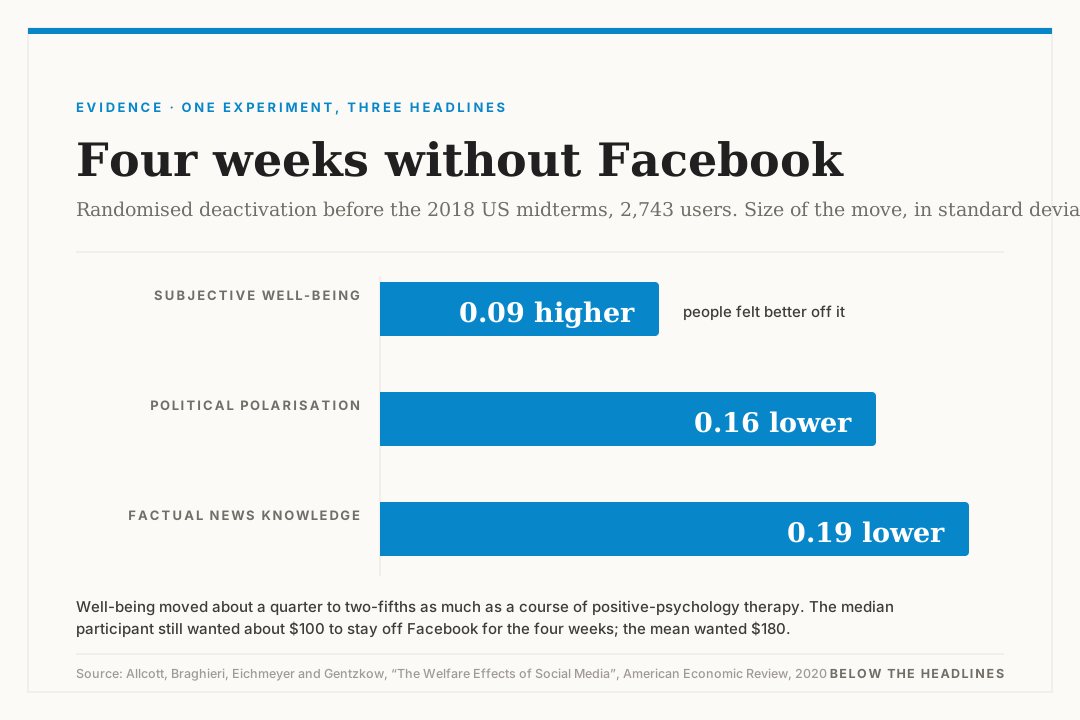
The benefit side of the ledger comes from the same paper. Weighted to resemble the average American user, the median participant wanted $100 to stay off for four weeks and the mean wanted $180. Multiply that mean by the 172 million US users of the day and four weeks of Facebook generates $31 billion of consumer surplus, which is nearly twice the entire settlement, from one app, in one country, in one month. The authors caution against annualising that, and they are right to.
Then comes the finding nobody quotes. After four weeks away, people’s valuation of going back fell by as much as 14 per cent. The largest number on the benefit side is partly a forecast, and people revise it downwards once they have run the experiment on themselves.
The evidence that keeps the argument open
Against all of that sits the most awkward paper in the field. Amy Orben and Andrew Przybylski ran three large datasets, 355,358 respondents in total, through a specification curve analysis and found that technology use explains at most 0.4 per cent of the variation in adolescent well-being, an association they compare to eating potatoes and rank as weaker than wearing glasses.
The deeper result is not the potatoes. It is that they counted more than 600 million defensible ways to analyse the same data, and that the analyst’s choices swamp the effect being measured. That is precisely why every party to this argument can cite real numbers and arrive somewhere different.
On the political harms, the strongest evidence comes from experiments Meta itself funded and did not control. Replacing algorithmic feeds with chronological ones during the 2020 election cut time on the platform sharply and moved neither issue polarisation, nor affective polarisation, nor political knowledge over three months. Removing reshared content reduced what people knew and left their politics alone.
So the record is: one strong causal finding of a modest effect on mental health, in a population and a product that no longer exist; a correlational literature so noisy it can be steered; and mostly nulls on democracy. On 26 August that stopped being a scientific dispute anyone had to resolve in a courtroom.
The costs that were never in the room
Eighteen hundred miles from that courtroom, in Richland Parish, Louisiana, Meta is building Hyperion. Announced at $10 billion, the project passed $50 billion in under two years, and it needs power on a scale the state does not currently have.
Entergy Louisiana proposed buying an ageing gas plant in south-east Texas for $1.8 billion, more than three times what it fetched when it last changed hands in 2024, an increase attributed predominantly to Hyperion’s demand. A consultant to the Public Service Commission found the purchase could add $8 to $13 a month to bills for 1.1 million residential customers. Entergy and Meta both dispute that reading, and Governor Jeff Landry signed an executive order in June intended to keep data-centre costs off household bills.
If the consultant is right, that is somewhere between $105 million and $170 million a year, from one state, charged to people whether or not they have ever opened Instagram. Compared with $1.27 billion a year flowing back to 51 jurisdictions, it is not a rounding error. No attorney general has put a number on it, because no lawsuit is shaped to ask.
There is a cost inside the company too. Meta cut about 8,000 jobs in May, roughly a tenth of its people, and ended June with 75,472 employees, down 1 per cent on the year, while spending $30.1 billion on property and equipment in a single quarter.
The part of the deal with a mechanism
Strip out the money and what remains is a consent judgment: daily usage limits for teenagers, night-time blocks, enhanced age assurance meant to keep children off the apps altogether, more tools for parents, and an independent auditor reporting on compliance for five years. Bonta says the changes arrive within months.
None of that appears as a cost on any balance sheet, and it is the only part of the settlement with a plausible route to changing an outcome. Money is a transfer. Product design is a mechanism.
The nearest thing to a test is Australia, which barred under-16s from social media in December 2025. By March the eSafety Commission reported that many young people were still getting in and opened investigations into five companies for inadequate age checks. Research reported this August found more than eight in ten teenagers still on the platforms; most 10- to 15-year-olds were using them as often in March as they had before the ban, their parents were less aware of the habit than before, and nothing measurable had shifted into sport, music, time with friends or community events. The workarounds are mundane: a VPN, a borrowed birthday, a face scan fooled by a photograph, or a migration to an app the law does not cover.
Age assurance is the load-bearing term of the Oakland consent judgment, and the one country that has tried it nationally has not made it hold.
What a real ledger would need
Try to add the two sides up and the units refuse to combine. The harm is measured in standard deviations on a depression index, in a study of a product two decades gone. The benefit is measured in what people say they would accept to log off, a figure they revise downwards after logging off. The payment is a ten-year annuity discounted by nobody in public. The externality is $8 to $13 a month on a power bill in Louisiana.
Nobody has built the exchange rate between those things, which is a large part of why this case settled. A verdict would have required someone to try.
The litigation is not finished. Florida is going to court, the school districts and the personal-injury claims are still consolidated and live, TikTok is still being sued by California, and Bonta has been careful to describe this as a floor. TD Cowen told clients that some of the legal overhang is now resolved, which is analyst for: less than we feared, and mostly not Meta’s problem any more.
Twenty-five days of revenue bought the end of a trial. It did not buy an answer to the question the trial was about, and by Meta’s own accounting the price of not finding out came in cheaper than six months of Reality Labs.
This is the layer below the headline.
Sources
Every figure in this piece traces back to a published document or report. Follow them.
- Meta settles social media addiction case with California, other states for $16.7 billionCNBC
- After Meta’s landmark settlement with state AGs, legal headaches remainCNBC
- He beat Big Tobacco. Will the same playbook work against Meta and social media?CNBC
- Meta reports second quarter 2026 resultsMeta
- Social Media and Mental HealthBraghieri, Levy and Makarin, American Economic Review
- The Welfare Effects of Social MediaAllcott, Braghieri, Eichmeyer and Gentzkow, American Economic Review
- The association between adolescent well-being and digital technology useOrben and Przybylski, Nature Human Behaviour
- How do social media feed algorithms affect attitudes and behavior in an election campaign?Science
- The Master Settlement AgreementW. Kip Viscusi, National Bureau of Economic Research
- Who is really benefiting from the tobacco settlement money?American Lung Association
- Meta data center to cause Entergy bill increaseAlliance for Affordable Energy
- Australia’s under-16 social media ban failing, study showsAl Jazeera