You leave a comment under a video. A few seconds later a message arrives. It uses your name, it answers the thing you asked about, and it carries a link.
Nobody wrote it. Nobody read your comment and decided you were worth a reply. A word you typed matched a rule, the rule fired, and the same message went to everyone else who typed that word. On a big account that can be twenty thousand people before lunch.
This is not a scandal, and the company that sold the tool is not hiding it. It is simply how selling works now, and it is worth looking at as a system rather than as an irritation, because the same substitution has happened at every step between the video and your card details.
What sits between the video and the payment
Start with the feed, which is the biggest business in the chain by a wide margin. Meta took $200.97 billion in revenue last year, with ad impressions up 12 per cent and the average price per ad up 9.
The advert you see there may never have met a camera. Higgsfield reached roughly $700 million in annualised revenue by August and HeyGen about $200 million; Arcads sells AI actors who will do an unboxing or a product demonstration to order. The question a marketing team asks has changed from which three adverts to make into which three thousand to test.
Then comes the recommendation, which is the part that matters, because it reaches you from somebody you chose to follow. That is no longer goodwill. It is plumbing, and it keeps records. ShopMy was worth around $410 million in January last year and $1.5 billion by October, and says it handles more than $1 billion of commerce a year. impact.com expects roughly $270 million in annual recurring revenue, and its systems tracked close to $120 billion of partner-referred sales in 2025. CreatorIQ reports creator budgets up 171 per cent in a year.
You comment. So do twenty thousand others. No human being can answer twenty thousand people and try to sell to each one, and that limit is what used to keep this kind of selling small. Manychat removes the limit: type the keyword, get the message. It has raised $140 million and moves billions of messages a year across Instagram, TikTok, WhatsApp and Messenger.
One €40 purchase, and everyone who earns
Every stage here was once capped by how much one person could do in a day. None of them is capped that way now.
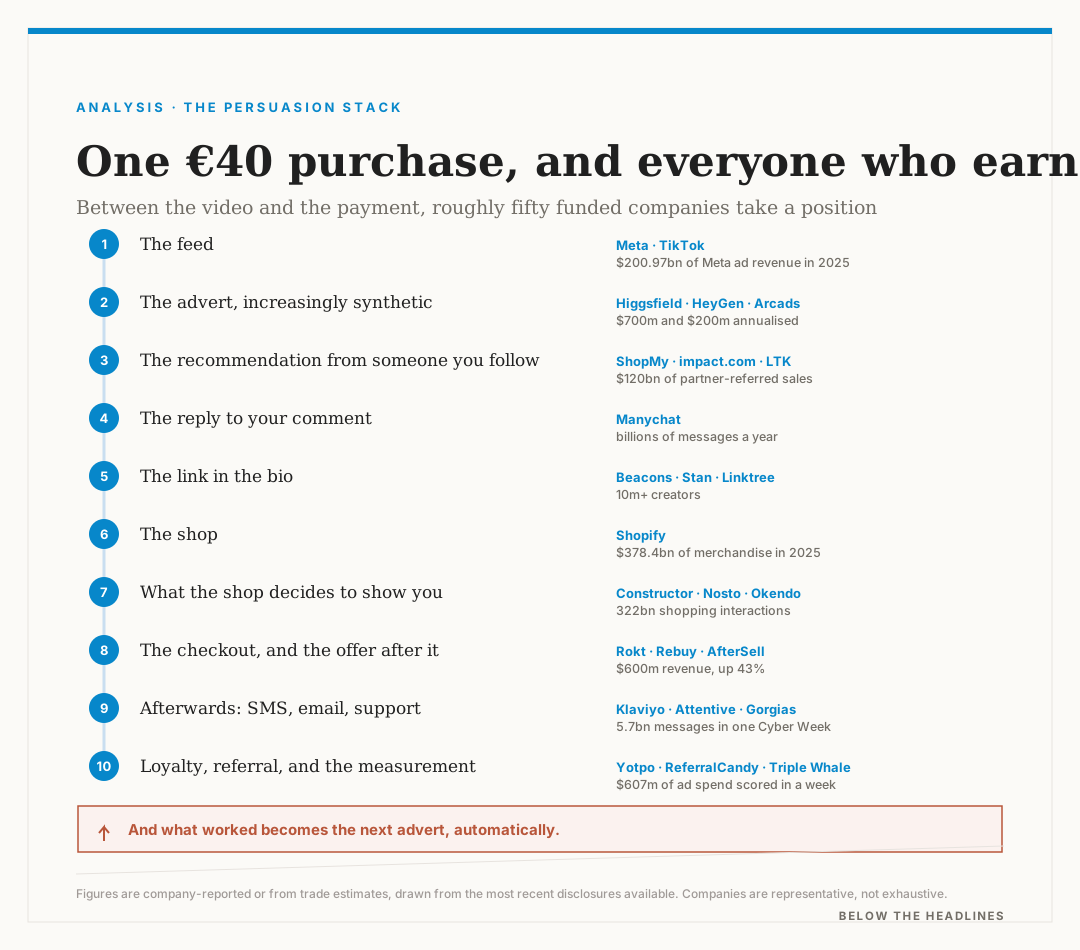
After that the path is well trodden. The link in the bio, where Beacons claims more than 10 million creators and Stan turns a following into a small shop. The shop itself, usually on Shopify, which moved $378.4 billion of goods last year. What the shop puts in front of you, chosen by Constructor, which says it handled 322 billion shopping interactions in its last financial year, or by Rebuy, which claims 50,000 Shopify brands and $3.8 billion of extra merchant revenue.
A quiz asks about your skin. It is genuinely useful and it is also the tidiest method anyone has found for getting people to write down what they want. Okendo reports one client seeing conversion among quiz-takers rise 436 per cent, which is a vendor case study rather than a law of nature, though it does tell you what merchants are paying for.
At the till, Rokt sells advertising into the one moment you have already proved you will spend money: about $600 million of revenue, growing 43 per cent, valued at $3.5 billion in a secondary sale. It has since bought AfterSell to push further into the minutes after you pay.
If you contact customer service, that is a place to sell too. Gorgias, at an estimated $69 million in annual recurring revenue, turns the support queue into another conversion point. Then loyalty, then a subscription, then a nudge to refer a friend, which turns your own address book into the next source of customers. Triple Whale or Northbeam measures all of it, so the machine can learn which bit worked; during Black Friday week in 2025 Triple Whale alone watched $2.9 billion of merchant revenue, 26 million orders and $607 million of advertising spend.
Whatever worked becomes the next advert.
Five jobs that stopped needing a person
Fifty companies sounds like fifty businesses. It is closer to five.
Five jobs that stopped needing a person
Each of the five makes the other four worth more, which is why they all arrived together rather than one at a time.
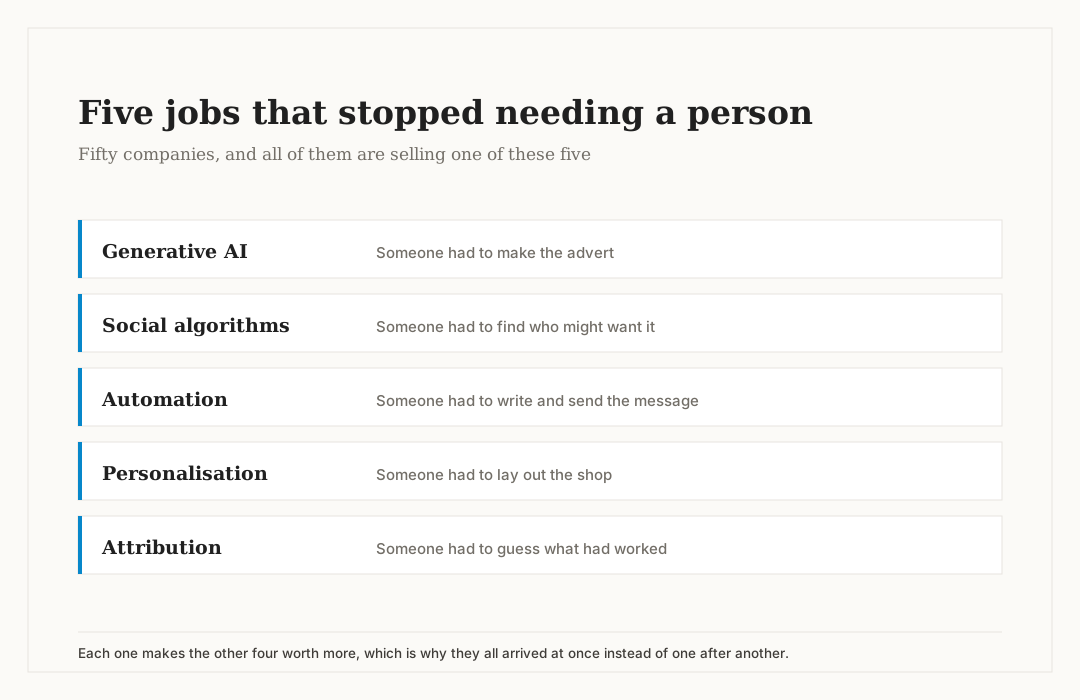
Cheaper adverts are worth more when the targeting is good. Good targeting is worth more when you can message people one at a time. Messaging is worth more when the page rearranges itself for whoever lands on it. All of it is worth more once you can prove which part produced the sale, because that tells the advert-making layer what to make next.
The messages nobody sent
Klaviyo, which took $1.234 billion in revenue last year, describes what it sells as an autonomous business-to-consumer CRM. That phrase deserves a slow read.
A marketer used to decide to email a customer on Tuesday. Increasingly the software decides: which person, on which channel, at which hour, with which product, at which discount, and what to do next depending on whether she opens it. The human input is a goal and a budget.
Attentive, past $500 million in annual recurring revenue, shows what that looks like at scale. During Cyber Week in 2025 its customers sent roughly 5.7 billion messages, 46 per cent more than the year before.
Attentive’s own guidance for 2026 puts the logic in one line: historically, more campaign volume during Cyber Week has produced more revenue. That is sound advice for any single brand. It is also sound advice for every other brand, and there are a hundred thousand of them. Nobody sets out to fill your phone. Each company simply does the thing that works, and a hundred thousand sensible decisions add up to nearly six billion messages in one week from the customers of one vendor.
The reason none of them stops is that the price of trying has collapsed for the sender and has not moved for you. Sending is close to free now. Reading is not, and nobody asked whether you wanted to.
Why it arrives looking like a friend
Look at where all this actually lands. A person you follow. A friend’s referral link. A WhatsApp message. An Instagram DM. A conversation with customer service. A quiz that offers to help. A review. Someone’s morning routine.
Advertising did not disappear when people stopped trusting it. It moved into the places people had not yet learned to check.
The regulator has measured how well that border holds. In its second influencer disclosure report the Advertising Standards Authority went through more than 50,000 pieces of content from over 500 UK-based Instagram and TikTok accounts. Full compliance had risen a long way since 2021, from 35 per cent to 57. Which is another way of saying that about a third of the adverts carried no disclosure at all, with a further 9 per cent labelled so vaguely it did not count. The updated guidance states the obvious conclusion: people cannot reliably tell influencer advertising from anything else.
What the children say
Be careful about causation here. There is no evidence that a direct-message tool harms a child, and pretending otherwise would be dishonest.
What does exist is a set of findings about the ground all of this is built on. In February the European Commission preliminarily found that TikTok’s infinite scroll, autoplay, push notifications and personalised recommendations breached the Digital Services Act through addictive design, the first enforcement aimed at how a platform is built rather than at what is posted on it. In July it reached a similar preliminary finding against Instagram and Facebook, saying the design pushes people into autopilot. Officials noted that TikTok is by far the most-used platform after midnight by children aged 13 to 18.
The commercial machinery described above runs on top of those feeds. A teenager’s evening is not simply TikTok. It is TikTok, then a beauty creator, then a recommendation carrying a commission, then a shop inside the app, then comments, then an automatic message, then a quiz, then a queue of texts for the next year.
The most useful evidence is what the children themselves said. In April the Commission asked almost 5,000 children across every member state what they wanted from the Digital Fairness Act. Fifty-eight per cent asked for better protection from personalised advertising and pricing. Sixty-nine per cent said influencers should only be allowed to sell them things that are safe and appropriate. Forty-eight per cent wanted rules on addictive design, and 72 per cent supported some form of age verification.
They are not asking for the internet to be turned off. They are describing this machine fairly precisely and asking somebody to put a limit on it.
The last human decision
None of the individual pieces is sinister. A quiz that finds the right moisturiser is helpful. A creator who actually likes a product is doing something real. A shop that remembers your size beats one that does not. Answering twenty thousand comments is, taken on its own, a service.
The problem is the total. Every layer took a kind of human contact that was limited by the effort it cost, removed the limit, and started selling the result by the unit. What made that contact worth having was that somebody chose to spend their time on you, and choosing is the part that has been automated away.
Which leaves one decision in the chain still made by a person, and it is yours.
This is the layer below the headline.
Sources
Every figure in this piece traces back to a published document or report. Follow them.
- Influencer ad disclosure reportAdvertising Standards Authority
- Commission preliminarily finds TikTok’s addictive design in breach of the Digital Services ActEuropean Commission
- Commission preliminarily finds the addictive design of Instagram and Facebook in breach of the DSAEuropean Commission
- Commission survey shows children want better rules to ensure digital fairness for allEuropean Commission
- Manychat raises $140M led by Summit PartnersSummit Partners
- Higgsfield raises $400M Series B at a $5.4B valuationTechCrunch
- Shopify fourth quarter and full year 2025 resultsShopify
- Klaviyo announces fourth quarter and full year 2025 financial resultsKlaviyo
- Meta reports fourth quarter and full year 2025 resultsMeta
- Addictive design on online platformsEuropean Parliamentary Research Service