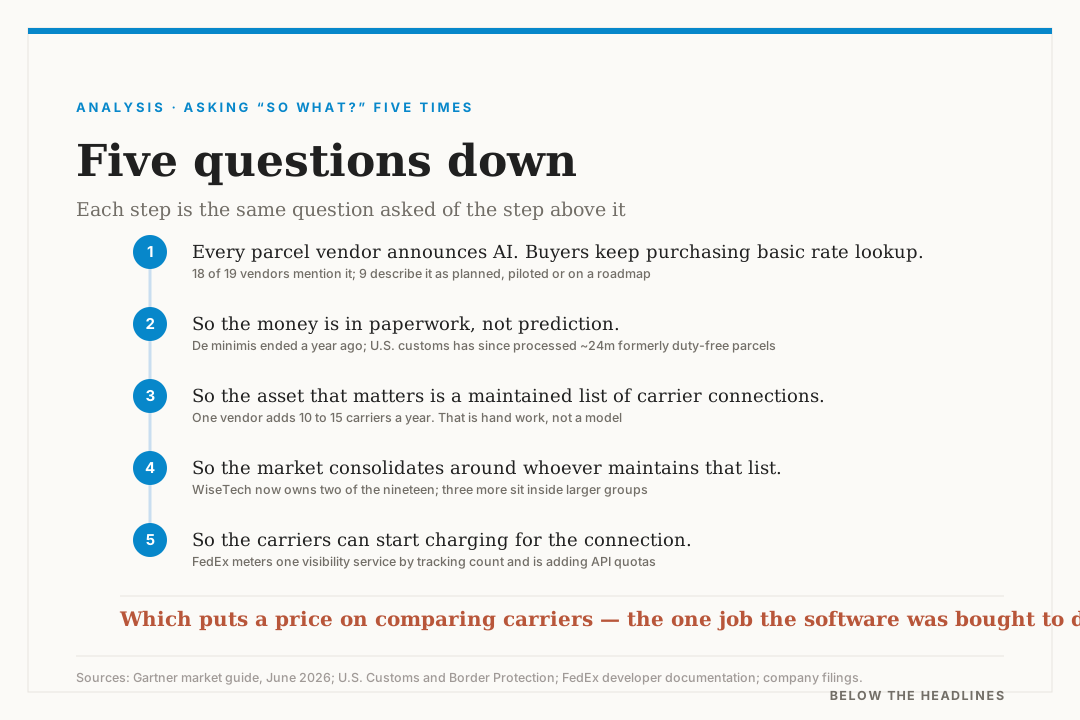
The observation on its own is mildly amusing and not much more. Every vendor in a market sells artificial intelligence; hardly any of their customers buys the part that would require it. You could file that under marketing and move on, and most coverage does.
What makes it worth following is what happens if you refuse to stop there. Take the gap, and ask what it is for. Then ask the same question of the answer, and keep going. Five steps in, the story is no longer about language on a website. It is about who controls a shipper’s ability to compare prices, and about a meter being quietly attached to it.
Each step below is checkable, and a couple of them turned out to be firmer than expected.
The starting point: eighteen of nineteen
Gartner published a market guide in June covering multicarrier parcel management software, the systems that choose a carrier, print the label and tell the carrier a package is coming. The guide profiles 19 vendors. Of those, 18 mention artificial intelligence. In nine of those 18 it is described as planned, in development, being explored, on a roadmap, or in pilot.
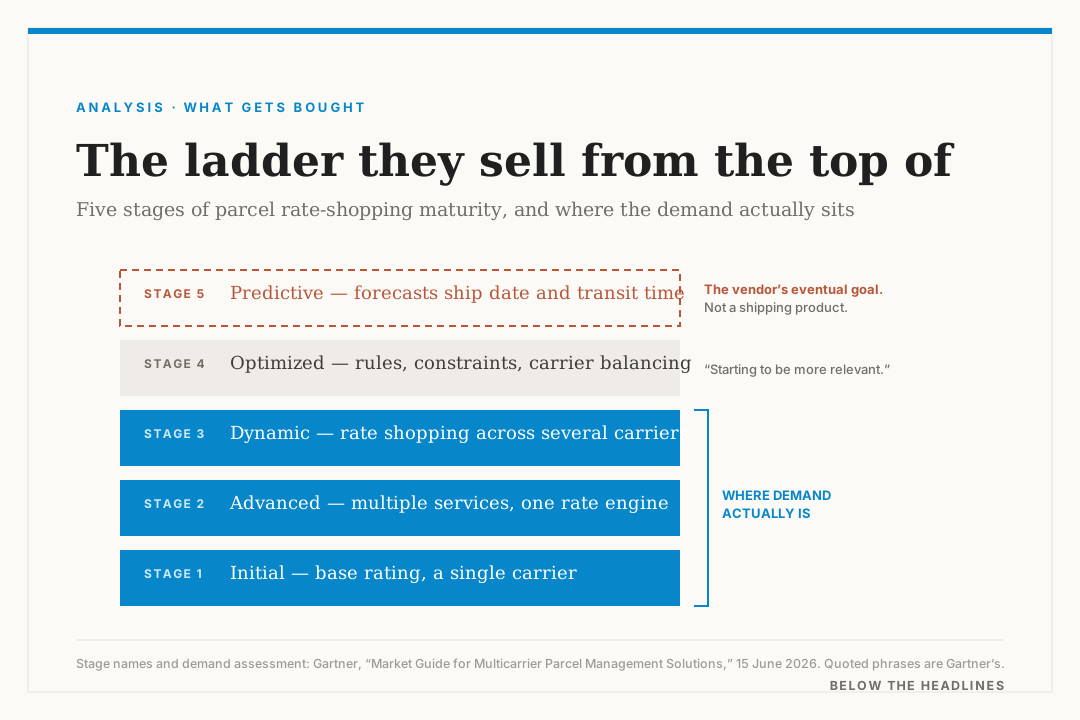
The guide also grades rating engines on five stages of maturity, ending at a Stage 5 system that predicts ship dates and transit times and picks carrier, rate and service by itself. That is the autonomous supply chain of the forecasts, described in the one document where it can be checked against what people actually purchase. Gartner’s assessment: demand sits at Stages 1 through 3, Stage 4 is “starting to be more relevant,” and Stage 5 is “the vendor’s eventual goal.”
The ladder they sell from the top of
Stage 5 is the product being marketed across the industry. It is also the only rung Gartner describes as an aspiration rather than a purchase.
So what? Because the money moved into paperwork
A year ago today, the thing that actually reorganised parcel operations arrived, and it had nothing to do with models.
The United States suspended the de minimis exemption on 29 August 2025, under an executive order signed the previous month. Shipments under $800, which had entered with minimal customs procedure, now needed duty assessment. Customs brokers began requiring full entry-level data: commodity classification codes, proper product descriptions, tax identifiers. A great many shippers did not hold that data anywhere in their systems. More than 30 countries suspended or limited postal shipments to the United States while carriers rebuilt their procedures. American customs has since processed close to 24 million parcels that would previously have come in duty-free.
That was the largest operational shock this industry has absorbed in years, and no part of it was an optimisation problem. It was a data-capture problem: attaching a correct commodity code and a tax identifier to a shoebox, reliably, at volume. The software that earned its keep over the last 12 months was the software that could carry an extra field and get the format right.
Which is the same thing the guide says stops shipments in ordinary times. If a carrier does not receive the right document in the right format, it can hold the consignment until somebody manages to reach the shipper. Nothing upstream compensates for that.
So what? Because the asset is a list, maintained by hand
If the purchasable value sits in compliance rather than cleverness, then the thing worth owning is a working, current connection to as many carriers as possible. The guide reads that way once you notice it. Centiro reports more than 2,000 carriers preonboarded. Locus claims integration with over 1,500. nShift has more than 1,000. e2open and ProcessWeaver are each above 450, Metapack has 350 carriers and 4,000 delivery services, and the numbers run down through the low hundreds to Sendflex at just over 60.
The revealing figure is not the size of any library but the rate at which one grows. Pierbridge, the guide notes, typically adds 10 to 15 carriers a year. That is not throughput produced by an algorithm. It is a team doing integration work one carrier at a time, and then keeping each connection alive as that carrier changes its label specification, its postal code tables and its manifest rules.
This is also why the displacement Gartner does report runs backwards relative to the pitch. Warehouse software vendors are taking business at the low end, because AI made the easy integrations cheap to build. The harder work, rate and service shopping, is “not yet challenged.” AI is compressing the bottom of the moat rather than the top, which is the opposite of a technology that handles complexity and leaves the simple jobs to people.
So what? Because lists like that get bought
An asset that is expensive to assemble, tedious to maintain and valuable to whoever holds it has predictable economics. It consolidates.
Read the roster of 19 independent-sounding vendors with that in mind. e2open was acquired by WiseTech Global in August 2025. Pierbridge is also part of WiseTech. Metapack is a subsidiary of Auctane. ProcessWeaver belongs to Elemica. Pitney Bowes sold its Global Ecommerce business in 2024 and now sells parcel software through what remained.
One acquirer holds two of the 19. Several others sit inside larger groups. What looks like a competitive market guide is partly a snapshot of an industry midway through being rolled up, and the rolling-up is being done by companies that understand exactly what the carrier libraries are worth.
So what? Because whoever owns the connection can price it
This is where the chain turns, and it is the step most worth checking carefully.
If the value of this software is its live connection to carriers, then the carriers are sitting on the input. And they have noticed. Gartner records, in a single line near the end of a section about external pressures, that some carriers have begun charging shippers for high-volume API queries, and that this is already pushing parcel vendors to handle tracking differently.
The public record is consistent with that, though it is worth being precise about how far it has gone. FedEx charges a monthly fee for its Advanced Integrated Visibility service based on the count of tracking numbers, and has introduced transaction quotas and rate limits across its APIs, describing the purpose as equitable distribution of system resources. UPS retired legacy access-key authorisation in the summer of 2025. FedEx retires its remaining older endpoints in June 2026, which forces every integration through the newer interfaces it controls and instruments.
Nobody has announced universal per-call billing for carrier data. What has been assembled is the machinery that would make it straightforward.
This has happened before, to other people
The pattern is familiar from well outside logistics, and it runs in three phases. A platform keeps its interface free while it needs an ecosystem. Outsiders build dependencies on that interface. Once the dependency is load-bearing, the interface acquires a price.
Reddit’s API was free from 2008 and charged for from April 2023, which closed most third-party clients within weeks. Google’s Maps platform repricing produced increases developers described in multiples rather than percentages. Twitter followed the same route. In each case the objections failed for one reason: by the time the invoice arrived, there was nowhere else to go.
Parcel carriers are earlier on that curve and hold a stronger position than any of those platforms ever did, because the dependency is physical. A developer can rehost an application. Nobody can rehost a delivery network.
So what? Because agents are polling machines
Now put the artificial intelligence back into the picture. Almost every capability promised across that market guide runs on frequent queries against carrier systems: predictive arrival times, exception scoring, autonomous rate shopping, and the carrier balancing Gartner describes vendors attempting, where they try to read live and predicted carrier capacity in order to place volume. A Stage 5 rating engine does not operate on an overnight batch.
An agent that checks constantly is a customer that queries constantly. If those queries carry a price set by the counterparty, then the marginal cost of autonomy is neither near zero nor under the control of the vendor selling autonomy. That is an uncomfortable position for a software business, and it appears in none of the market forecasts, which model AI adoption as a function of capability rather than of data access terms.
It also gives a sharper reading of the scepticism Gartner reports. Buyers demanding transparency, measurable return and “strong data foundations” before trusting black-box optimisation are usually described as cautious. They may simply be further through this reasoning than their suppliers.
What is actually being priced
Rate shopping is not a feature. It is the mechanism by which parcel prices stay competitive at all. A shipper that can compare a dozen carriers on cost, service and zone at the moment a box is packed is applying the only continuous pressure a carrier faces. The entire maturity ladder is a description of that comparison getting sharper as you climb it.
Three things are now happening to that comparison at once. The vendors who perform it are consolidating into a few owners. The data required to perform it is acquiring a metered price, set by the parties being compared. And the largest parcel carrier by volume in the United States, as of 2025, is Amazon Logistics, which is simultaneously a carrier, a retail competitor to a good share of the shippers using it, and a seller of the cloud capacity that comparison software runs on.
Gartner reports retailers already uneasy about that last point, framed as a reluctance to fund the competition. It is the right instinct aimed at the wrong object. The exposure is not only the freight invoice. It is the ability to shop.
What to watch, because it will not be announced
None of this arrives as a launch. It arrives as terms.
Watch whether carrier API pricing moves from quotas to per-query billing, and whether tracking is separated out and charged for on its own, as FedEx has already done for one visibility product. Watch whether parcel vendors begin quietly advertising cached or inferred tracking instead of live tracking, which is precisely what you would expect once queries carry a cost. Watch the carriers-added-per-year figures, because that is the real productivity measure in this market and the first number that would move if the AI claims were doing any work. And watch who buys whom, which is the clearest statement anyone in this industry is making about where the value actually sits.
The AI announcements will keep coming. They cost nothing to make, and buyers have been trained to expect them. The thing worth following is quieter, is written into interface documentation rather than press releases, and now has a meter on it.
This is the layer below the headline.
Sources
Every figure in this piece traces back to a published document or report. Follow them.
- Market Guide for Multicarrier Parcel Management Solutions, 15 June 2026 (ID G00839356)Gartner — Tunstall, Johns and Sanchez Duran
- 7 Supply Chain Trends in 2026Coursera
- The end of the U.S. de minimis exemption: what it means for businessDHL
- CBP has processed nearly 24 million parcels that would have been duty-free since the U.S. ended de minimisYahoo News
- New quotas and rate limits on API requestsFedEx Developer Portal
- Carrier API changes are coming in 2026ShipperHQ
- Reddit API controversyWikipedia
- MIT report: 95% of generative AI pilots at companies are failingFortune, via Yahoo Finance
- Parcel Shipping Index (Gartner’s cited source for 2025 US carrier volumes)Pitney Bowes